



Combinatorics Seminars
Feb 25, 2026 01:00 PM
328 Parker Hall

Speaker: Donggyu Kim, (Georgia Institute of Technology)
Title: Pseudo-orientable ribbon graphs
As consequences, we obtain the Matrix--Quasi-tree Theorem for pseudo-orientable ribbon graphs and the log-concavity on a sequence \(q_i\) counting quasi-trees of size \(2i-1\) or \(2i\). To prove the latter result, we generalize Stanley's log-concavity theorem for regular matroids to regular \(\Delta\)-matroids. Finally, we exhibit an infinite family of non-pseudo-orientable ribbon graphs that fail to satisfy log-concavity.
This is joint work with Changxin Ding.
DMS Combinatorics Seminar
Feb 18, 2026 01:00 PM
328 Parker Hall

Speaker: Alec Helm (University of South Carolina)
Title: Optimal Drawings of Infinite Graphs
Abstract: A drawing of a graph is an association of vertices to distinct points and edges to Jordan curves which run between the points associated to the edge’s endvertices. If these edge curves pairwise intersect only at mutually incident endpoints, we call the drawing an embedding. Famous 1930’s theorems of Wagner and Kuratowski give necessary and sufficient conditions for a finite graph to admit an embedding in the plane, but less known is Wagner’s 1960’s theorem giving necessary conditions for a (possibly infinite) graph to admit a plane embedding. In this talk, we will briefly discuss Wagner’s Theorem and use it as a springboard to investigate the crossing number of infinite graphs. The crossing number of a graph is the minimum number of edge intersections needed to draw the graph in the plane, and thus a graph admits a plane embedding if and only if its crossing number is zero. We show the conditions under which a graph's crossing number is well-defined, and give a characterization of the crossing number of most graphs. Along the way, we extend many classical concepts from the study of finite graph crossing number to the infinite case, such as topological minor monotonicity, the notion of augmented drawings and graphs, and niceness in graph drawing
DMS Combinatorics Seminar
Feb 11, 2026 01:00 PM
ZOOM

Speaker: Gexin Yu (William & Mary)
Title: Routing in cycles via matchings
Abstract: Let \(G\) be a graph whose vertices are labeled \(1,\ldots,n\), and \(\pi\) be a permutation on \([n] := \{1,2,\ldots,n\}\). A pebble \(p_i\) that is initially placed at the vertex \(i\) has destination \(\pi(i)\) for each \(i \in [n]\). At each step, we choose a matching and swap the two pebbles on each of the edges. Let \(rt(G,\pi)\), the routing number for \(\pi\), be the minimum number of steps necessary for the pebbles to reach their destinations. Li, Lu, and Yang proved that \(rt(C_n,\pi)\leq n-1\) for every permutation \(\pi\) on the \(n\)-cycle \(C_n\) and conjectured that for \(n \geq 5\), if \(rt(G,\pi)= n-1\), then \(\pi=(123\cdots n)\) or its inverse. He, Valentin, Yin, and Yu proved the conjecture for all even \(n \geq 6\). In this talk we will show how to prove the entire conjecture.
This is joint work with Xiangjun Li and Xia Zhang.
DMS Combinatorics Seminar
Feb 04, 2026 01:00 PM
328 Parker Hall
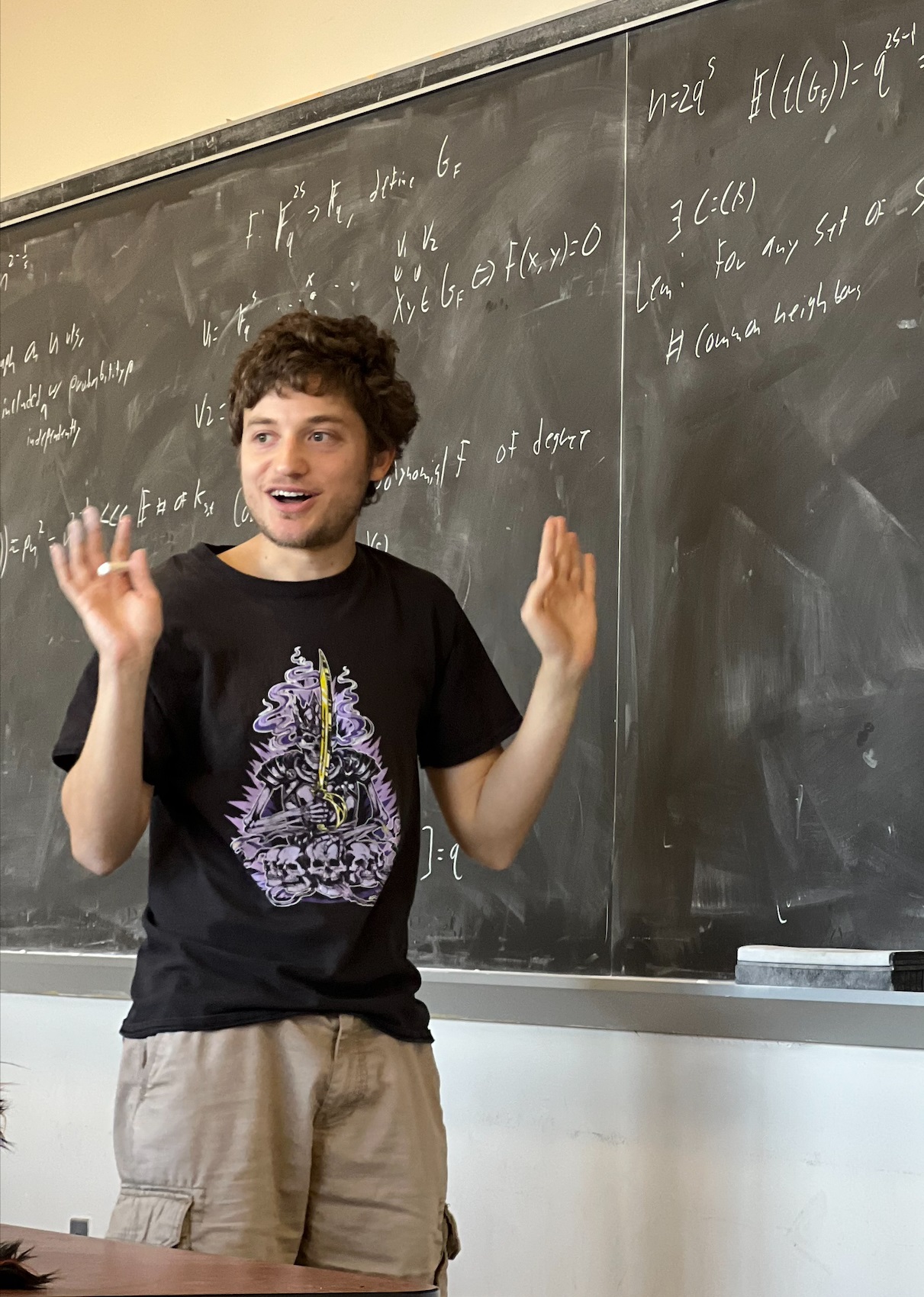
Speaker: Sam Spiro (Georgia State University)
Title: The Small Quasikernel Conjecture
DMS Combinatorics Seminar
Jan 28, 2026 01:00 PM
ZOOM

Speaker: Yuping Gao (Lanzhou University)
Title:Vertex-distinguishing edge coloring of graphs
Abstract: Given an integer \(k\ge1\), an edge-\(k\)-coloring of a graph \(G\) is an assignment of \(k\) colors \(1,\ldots,k\) to the edges of \(G\) such that no two adjacent edges receive the same color. A vertex-distinguishing edge-\(k\)-coloring of \(G\) is an edge-\(k\)-coloring such that for any two distinct vertices \(u\) and \(v\), the set of colors taken from all the edges incident with \(u\) is different from that taken from all the edges incident with \(v\). The vertex-distinguishing chromatic index, denoted \(\chi'_{vd}(G)\), is the smallest value \(k\) such that \(G\) has a vertex-distinguishing edge-\(k\)-coloring. In this talk, we present some recent progress on vertex-distinguishing edge colorings.
This work is joint with Songling Shan, Guanghui Wang, and Yiming Zhou.
DMS Combinatorics Seminar
Jan 21, 2026 01:00 PM
328 Parker Hall
Speaker: Guantao Chen (Georgia State University)
Title: Adjacent cubic vertices in a minimal brick
Abstract: A connected graph \(G\) is called a matching covered graph if \(E(G)\neq\emptyset\) and every edge of \(G\) lies in a perfect matching, that is, a matching covering all vertices of \(G\). A matching covered graph is said to be bicritical if, for any two distinct vertice \(x,y\in V(G)\), the graph \(G-x-y\) has a perfect matching. A brick is a 3-connected bicritical graph, and it is minimal if the deletion of any edge destroys this property. A well-known conjecture of Lov\'asz asserts that every minimal brick contains two adjacent cubic (degree-3) vertices.
In this talk, we present progress toward Lovász’s conjecture and establish several partial results. In particular, we show that every minimal brick contains two cubic vertices at distance at most two. We also verify the conjecture for minimal bricks with average degree at least \(4.5\). As a consequence, we deduce that every minimal brick contains two adjacent vertices of degree at most five.DMS Combinatorics Seminar
Jan 14, 2026 01:00 PM
ZOOM

Speaker: Abhishek Dhawan (University of Illinois Urbana-Champaign)
Title: A survey of near-Vizing edge-coloring
This talk is partially based on joint work with Anton Bernshteyn.
DMS Combinatorics Seminar
Nov 19, 2025 02:00 PM
ZOOM

Speaker: Noga Alon (Princeton University)
Title: Vantage Points and Sign Patterns
Abstract: Motivated by a possible application in Social Choice, I will discuss a recent work with Defant, Kravitz and Zhu that studies the number of ways to order points in the plane or in higher dimension according to the sum of their (Euclidean) distances from chosen vantage points.
A crucial mathematical tool here is an extension of results of Milnor and Warren about sign patterns of real polynomials, that have been used in the study of several problems in Discrete Mathematics and theoretical Computer Science, to a version that deals with sign patterns of more general functions.
DMS Combinatorics Seminar
Nov 12, 2025 02:00 PM
328 Parker Hall

Speaker: Xiaofan Yuan (Arizona State University)
Title: Tight minimum colored degree condition for rainbow connectivity
Abstract: Let \(G = (V, E)\) be a graph on \(n\) vertices, and let \(c : E \to P\), where \(P\) is a set of colors. Let \(\delta^c(G) = \min_{v \in V} \{ d^{c}(v) \}\) where \(d^c(v)\) is the number of colors on edges incident to a vertex \(v\) of \(G\). In 2011, Fujita and Magnant showed that if \(G\) is a graph on \(n\) vertices that satisfies \(\delta^c(G)\geq n/2\), then for every two vertices \(u, v\) there is a properly-colored \(u,v\)-path in \(G\). We show that for sufficiently large graphs \(G\) the same bound for \(\delta^c(G)\) implies that any two vertices are connected by a rainbow path.
This is joint work with Andrzej Czygrinow.
DMS Combinatorics Seminar
Nov 05, 2025 01:00 PM
328 Parker Hall

Title: Maximum in-general-position set in a random subset of \(\mathbb{F}_q^d\)