


Robert P. George and Cornel West disagree on plenty. What they refuse to disagree about is the importance of seeking truth.
That shared conviction, and the decades-long friendship they have built across philosophical and political differences, took center stage Sept. 30 as the nationally prominent scholars challenged members of the Auburn community to think critically, question their own assumptions and have the courage to engage seriously with ideas different from their own.
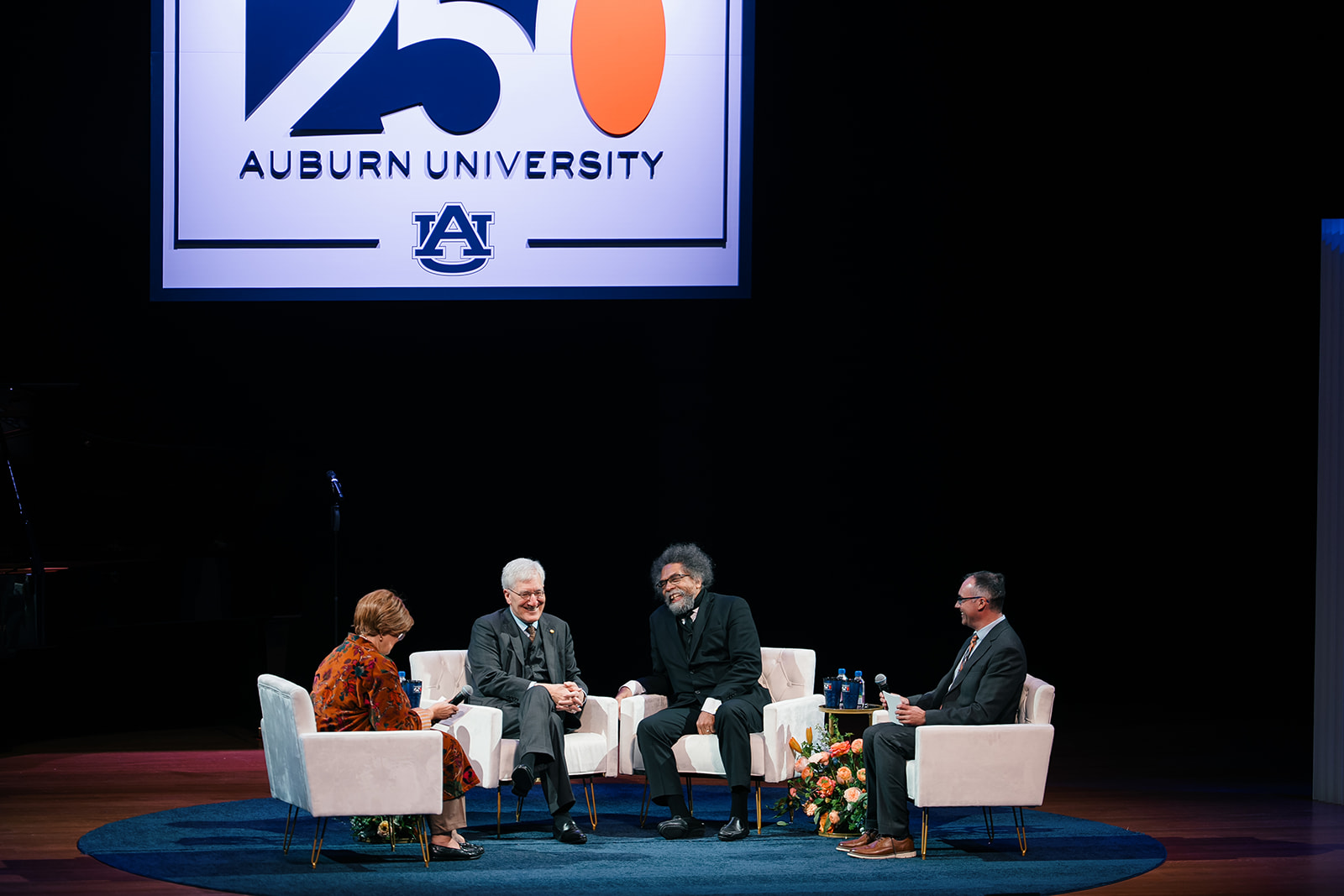
Appearing at the Jay and Susie Gogue Performing Arts Center as part of the university’s Democracy in Dialogue Signature Speaker Series, George and West explored what they see as essential to sustaining a healthy democracy, challenging the audience to pursue truth with courage and humility while cultivating the character necessary for responsible citizenship.
For universities like Auburn, West argued, preparing those citizens requires far more than transmitting knowledge.
“You need institutions of education that are cultivating people to muster the courage to think critically, muster the courage to hope and muster the courage to love,” West said. “The quest for truth, quest for beauty, quest for goodness and, for [George] and myself, quest for the holy. Because the spiritual dimensions, the moral dimensions and the civic dimensions mean much more than just words on paper.”
The conversation was the second installment of Auburn’s Democracy in Dialogue Signature Speaker Series, launched this spring as part of the university’s commemoration of America’s 250th anniversary. The series brings prominent voices to campus to encourage reflection and meaningful conversation about the principles, responsibilities and ideas that have shaped American democracy.
Disagreement without division
Known for their differing ideologies and perspectives on many of the nation’s most consequential issues, George and West offered more than arguments for civil discourse. Their decades-long friendship provided an example of what it can look like in practice. Rather than allowing their differences to become barriers, the two scholars have built a friendship around a shared commitment to seeking truth, challenging one another and remaining open to the possibility of being wrong.
Throughout the evening, they encouraged members of the Auburn community to do the same.
As longtime professors and scholars, George and West argued that universities should be places where ideas are tested rather than protected from scrutiny and where students learn not simply what to think, but how to evaluate evidence, consider competing arguments and develop convictions of their own.
“Challenge any proposition because there is no orthodoxy,” George offered. “Challenge any proposition so long as you do business in the currency of reasons, evidence and arguments.”
The pursuit of truth remained a thread throughout the evening, shaping a broader conversation about higher education, responsible citizenship and the health of American democracy.
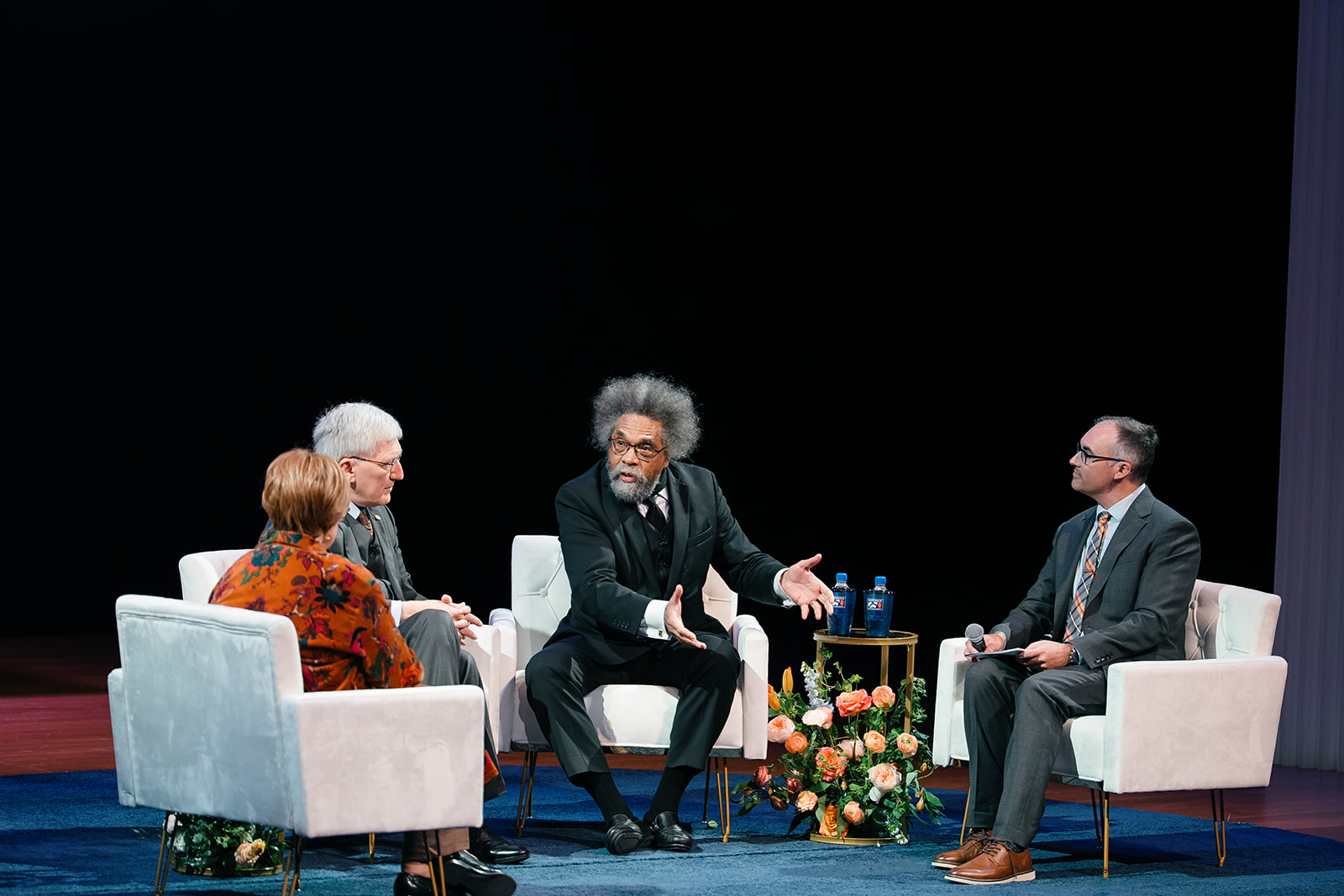
Moderated by Auburn professors Susan Filippelli and Jeffrey LaMondia, the discussion explored the character and civic virtue necessary to sustain democratic principles and the responsibility individuals have to seek truth with courage and humility.
Both scholars argued that democratic institutions cannot sustain themselves. Constitutions, laws and systems of government ultimately depend on the character of the people entrusted with them.
George pointed to James Madison and the nation’s founding principles to make that distinction.
“The answer Madison gives us is that what’s primary is virtue in the people,” George said. “It’s indispensable. You can have those constitutional words on the page, and they’re meaningless without virtue in the people.”
Finding a voice instead of an echo
That need for individual character, George and West argued, has become even more important in an environment where technology makes it increasingly easy for people to surround themselves with opinions they already share.
They challenged audience members to resist ideological silos and seek out ideas that complicate, test or even contradict their own.
For West, the difference is between developing a voice and becoming an echo.
“Find your voice and don’t just be an echo,” West said. “An echo is just an extension of a silo, but a voice is distinctive just like a fingerprint. Which means you have undergone deep education.”
Finding that voice, he argued, requires more than adopting the positions of a political party, social group or favored source of information. It requires education, reflection and the willingness to form convictions that can withstand serious examination.
It also requires humility.
Throughout the discussion, George and West returned to the idea that truth seeking demands both the courage to defend a conviction and the humility to recognize that one’s own understanding may be incomplete.
Their message was particularly relevant for students who are still deciding what they believe and what principles will guide them.
The goal, they suggested, should not be to leave college with an answer to every question. It should be to leave with the intellectual and moral habits necessary to keep asking better ones.
A challenge to the next generation
As the evening drew to a close, George and West were asked what charge they would give the next generation when encountering ideas that challenge their beliefs.
Their answer returned to the themes that had shaped the conversation. Seek truth, reject intellectual complacency and approach disagreement with courage and humility.
West then turned that challenge directly toward Auburn and the South.
“In 2026, people are looking to the South and saying, ‘Where is the visionary leadership? Where is the spiritual awakening? Where are the moral ways of enacting serious truth telling with humility?’” West added. “It has a disproportional effect on the whole country. There is something special about Auburn University. Auburn has a crucial role to play not just for Alabama, not just for the region, not just the country, but for the world.”
Students take the conversation further
The themes George and West explored before the larger Auburn community had already taken shape earlier that day in a conversation with students.
Earlier in the day, the scholars met with a group of students, including members of Auburn’s Foundation Fellows Program, for a smaller discussion designed to give students the opportunity to engage directly with them.
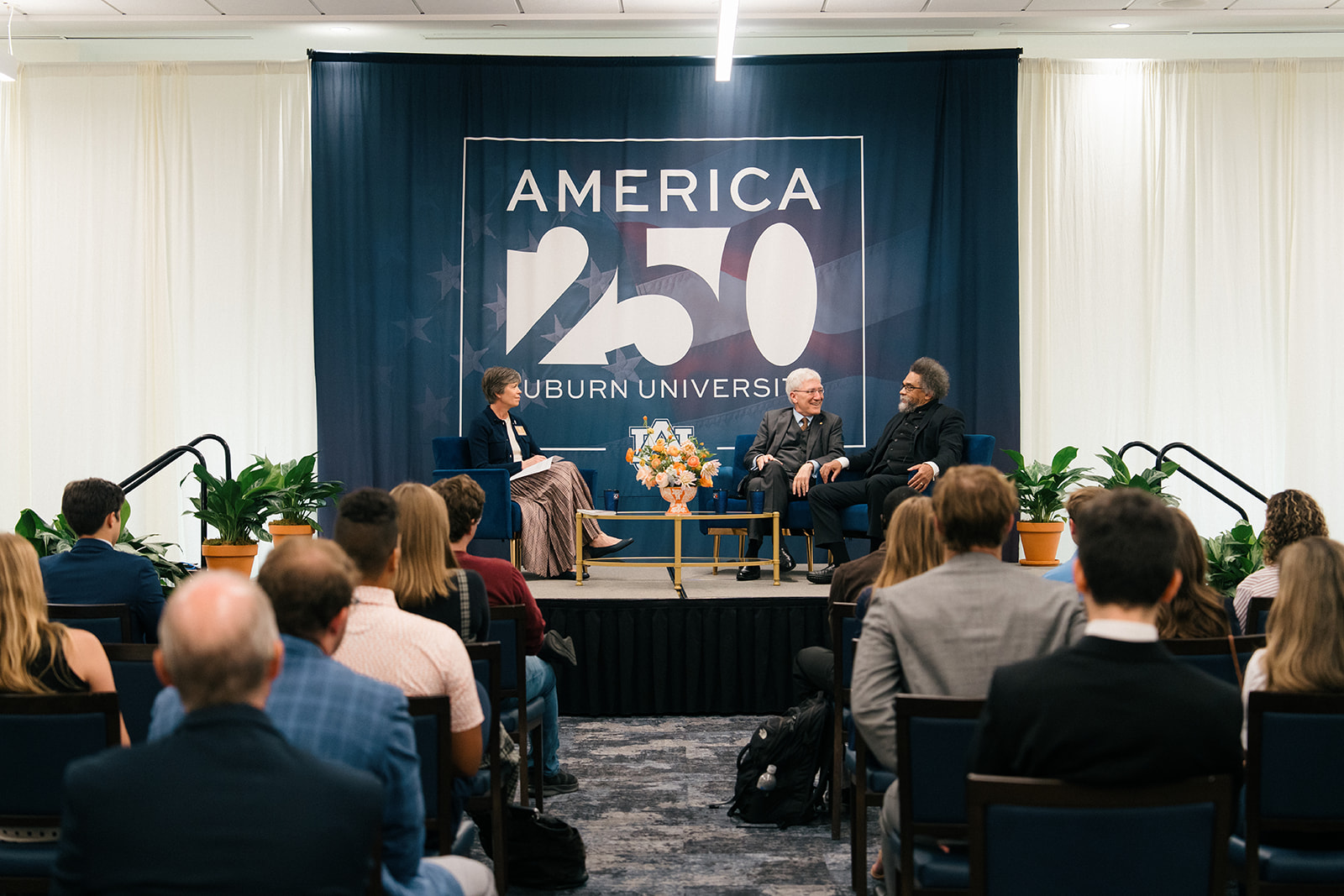
The discussion was as personal as it was philosophical, with questions that brought the larger themes of truth, conviction and disagreement into students’ own lives. Exploring how they can develop their beliefs without feeling pressure to have everything figured out, when to speak and when to listen, and the strength that can come from simply saying, “I don’t know,” the conversation reflected many of the ideas George and West explore in their 2025 book, Truth Matters: A Dialogue on Fruitful Disagreement in an Age of Division, while giving students an opportunity to consider what those principles mean for them.
George and West encouraged them to approach difficult questions as truth seekers rather than partisans, pairing conviction with intellectual humility and remaining willing to listen, reconsider and learn.
Their message reframed education as something larger than the acquisition of knowledge. Education, they argued, also develops the character required to use that knowledge well. It requires the honesty to examine evidence, the humility to question one’s assumptions, the courage to defend a well-reasoned conviction and the willingness to engage seriously with those who disagree.
For Jalen Walker, a junior pre-law major and member of the inaugural Foundation Fellows, seeing George and West model those principles made the experience particularly meaningful.
“Hearing from Dr. Robert George and Dr. Cornel West at both the student event and the Speaker Series was an experience I will not forget,” Walker said. “I think that hearing from two prominent philosophers of our time who stand on opposite sides of the political spectrum while having such a profound friendship underscores the value of open dialogue and respectful civil discourse.
“As college students, the future of America’s next 250 is in our hands, and conversations like these only help us to reflect on the ideals and values that have carried our democracy.”
It was a fitting reflection on a day centered not on asking Auburn students to agree, but on challenging them to do something more difficult. Think for themselves, listen to others and have the courage to pursue truth wherever it leads.
For those unable to attend the talk, a recording is available on the America 250 at Auburn University website until Oct. 30 (AU login required).