Current Lab Projects
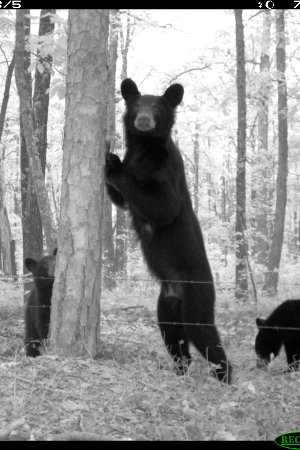
Black bear reproductive ecology in Alabama
The black bear was once common in Alabama. In fact, the range
distributions of three separate subspecies of black bears (the Florida
subspecies, Louisiana subspecies, and the American subspecies) once met in this
state. Today, there are probably fewer than 500 individuals in Alabama, all
concentrated in two small populations: a remnant population of the Florida subspecies of
black bears north of Mobile (with maybe 200 breeding bears), and a newly re-established population of the
American subspecies in northeast Alabama (with maybe 40 breeding bears). My lab recently completed a multi-year state-wide study attempting to
understand some very basic, but important information about black bears in
Alabama, including: how many there are, where they are, what habitats they use,
the degree of inbreeding in the population, and connectivity and gene flow
between populations both within the state and with other, surrounding states
(see Draper et al. 2017).
From that study, one concern that developed was why the Mobile population isn't
growing more. Anecdotal evidence suggests that bears cubs aren't making it to
adulthood and recruiting into the population. Thus, graduate student Jenna Malzahn and research assistant Hannah Leeper are radio-collaring female bears,
visiting dens over-winter, and radio-collaring cubs to monitor survival to their
first fall. Due to concerns about insufficient denning structure, we are also
putting supplemental dens in areas used by bears to see if such structures will
be used and how they will influence cub survival.
The evolution of scatterhoarding
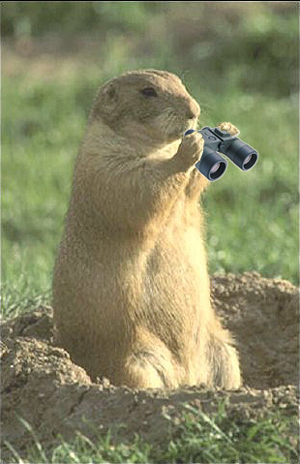
If you ask most people how squirrels survival over winter,
they will tell you that squirrels bury nuts in the fall to eat throughout the
winter when food isn't readily available, a process called 'scatterhoarding'.
Yet the evidence for the importance of such behavior and how it evolved in
animals like squirrels is limited. Thus, Ph.D. student Sarah Wilson (co-advised with
Steve Dobson)
is exploring the costs, benefits, and other details about this important
behavior in order to understand it's evolution and importance to squirrel
populations.
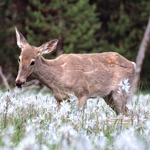
Do deer fawns choose hiding spots to mask their scent
It's commonly believed that deer fawns don't have a smell in
order to avoid detection by scenting predators. Of course, that simply is not
true. Graduate student Tanner Hough is starting an experiment using the
EcoDogs to see if
fawns choose hiding spots that mask their scent relative to random sites in the
environment. As animals that primarily use sight, we assume that most prey hide
in places that provide visual cover. But there are many predators (like coyotes)
that use smell to hunt. The study has important implications for predator-prey
theory.
Factors influencing road mortality in squirrels
The common gray squirrel is one of the most common species hit and killed on the road. Yet, little is known about the factors that influence road mortality in this species. Thus, undergraduate research fellow Madison McCown is collecting locations of vehicle-killed squirrels and comparing various attributes of those locations - like speed limit, traffice volume, habitat attributes on the side of the road - to randomly chosen locations. This research may provide insight into how to mitigate road mortality for the this common urban species.
For information on past projects, see the list of publications
|