
BOWLS Cruise Blog
Day 6
June 27, 2014
47° 30.20' N 125° 50.82' W
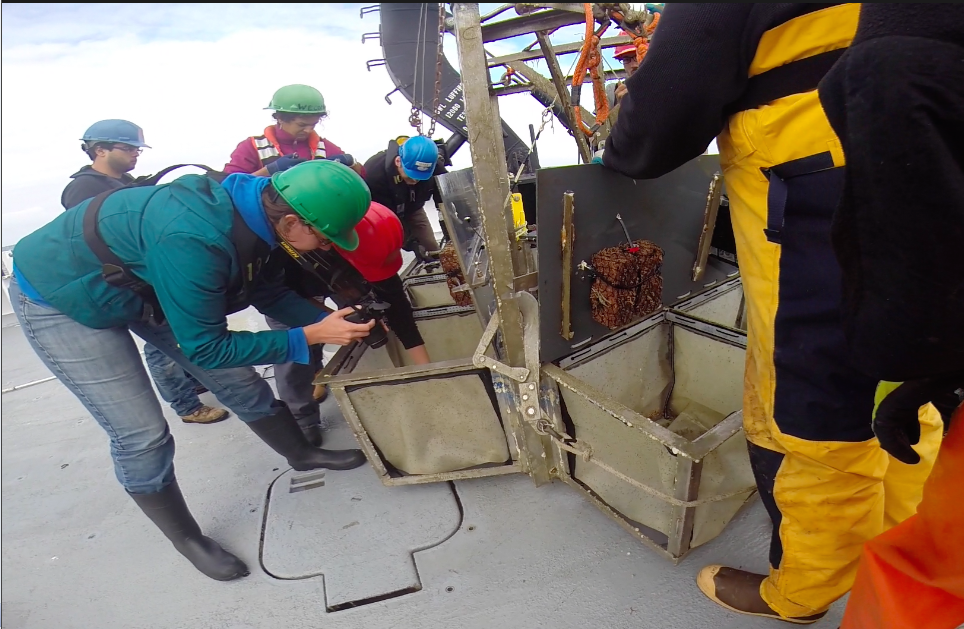 Team members processing the items from the landers. |
One of the key parts of our experiments is looking at the animals that live on whale bones in the deep-sea, but what makes them so special?
Whale bones are amazing biological structures, the result of millions of years of evolution, that help whales to survive throughout the world’s oceans. Many of the unique features of whale bones are aimed at combating negative buoyancy (sinking forces). Firstly, their bones are very porous and consist almost entirely of a honeycomb structure, with only a thin layer of compact bone. This means that there is less mineralized bone tissue to weigh them down. Secondly, the pore spaces of the honeycomb bones are filled with a very fatty bone marrow. Since these fats are less dense than water they also provide positive buoyancy. Both of adaptations have consequences for the animals that colonize whale skeletons when they die and sink to the seabed.
The fats in the bone slowly degrade, providing a long lasting energy source for many animal species living in and on the bone. As the bone are degraded by bacteria, reduced chemical compounds are emitted from the bones, which are used by other bacteria to create food through the process of chemosynthesis. These chemosynthetic bacteria can form thick mats of white, yellow or red bacteria that coat the bone. Many different animals specialise on grazing these bacteria, like the ‘snow-broader’ worms that leave winding tracks as they consume the bacterial mats. Others, like crabs and snails scrape away and eat pieces of the bone as they graze on the bacteria. Like grass on land, the bacterial primary productivity provides the basis of a complex food web.
 Osedax worms |
As the fats degrade this opens up the bone to animals looking for a home. The porous structure of the bone provides a micro-habitat for hundreds of tiny animals (mostly worms) that live in the pore spaces. Some of the animals actually eat the fats too! All of the animals living on the bone attract predators. In our boxes we found an octopus, large crabs and a fish – all of which were probably attracted by the food on offer!
Perhaps the weirdest (and most beautiful) animals on the bones are Osedax worms, literally bone devouring worms. They are only found on the skeletons of dead marine animals on the seafloor and make a living by extracting nutrients from the bone with their fleshy ‘root’ tissues that grow into the bone and dissolve it with acid. They embed themselves into the bone and It is analogous to the fungi that slowly digest a log in the forest, recycling the nutrients locked up in the bone. It is this process that we are particularly interested in just how fast do these bizarre animals ‘eat’ the bone and how does this affect the other animals living on the bones?
Dr. Nick Higgs
Plymouth University Marine Institute
Last updated: 06/29/2014