
BOWLS Cruise Blog
Day 1
June 22, 2014
43° 54' N 125° 52' W
 Photo of Velella velella also known as By-the-wind sailor |
A team of 13 scientists left Newport Oregon Sunday morning on the R/V Oceanus to recover experimental landers placed on the seafloor 14 months before. The purpose of the work is to explore how deep-sea ecosystems function, how diverse these deep-sea regions are, and how they are genetically connected to each other. The landers are custom-made by the science team to carry, and return, several sets of substrate including wood, whale bone and control substrates.
Oceanographic research often includes international teams; a fact that could not be more true of this group which contains scientists from the USA, Brazil, England, Germany, Trinidad & Tobago, and the Bahamas. Of course the diversity of the group makes checking in on World Cup Soccer pretty lively! Craig Smith (Univ. or Hawai’i) is the Chief Scientist of the cruise made possible by a National Science Foundation Grant to himself and Ken Halanych (Auburn University).
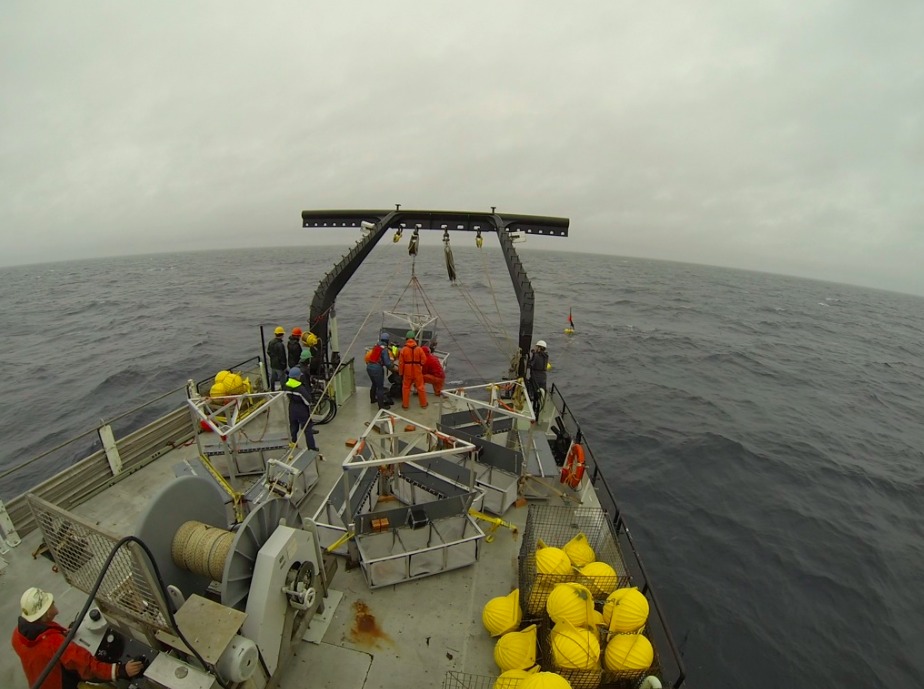 Deploying the landers in 2013 |
After leaving Newport at about 11:30am, we only had about 5 hours more to finish making our preparations before scientific work began. As we were steaming out we had a very pleasant surprise of coming across millions of a particular blue jelly called a By-the-wind sailor (Velella velella see picture 1). We passed through these and continued to our landers we were recovering. These experiments have been at the bottom of the ocean, and hopefully, zombie worms (Osedax) have been infesting the bones, and Xylophaga, a type of shipworm, have been eating away at the wood we left. However we were most apprehensive about whether the landers would return to the surface. A lot can happen in 14 months!! These landers are anchored to the bottom by an acoustic release. (Picture 2 shows use deploying a lander in 2013.) We have to return to the same spot where we deployed the landers and then send a signal to them to drop their weights and return to the surface. Let’s hope the batteries didn’t die while it was at the bottom.
OK time to get ready and see if our 1st payload comes back. We have 6 landers down and about two weeks to find them and process all the animals they should return!
Ken Halanych
Last updated: 06/24/2014