The common threads that join our research interests together are
the topics of bacterial virulence, antibiotic resistance, and
discovery of new leads for antibiotic development. Toward the
latter, we are intersted in new leads that will combat infection
by Mycobacterium tuberculosis. We are also interested in
compounds to address a variety of fungal and oomycete agricultural
pathogens. We focus on three main systems. Read more about each
one by following the corresponding links.
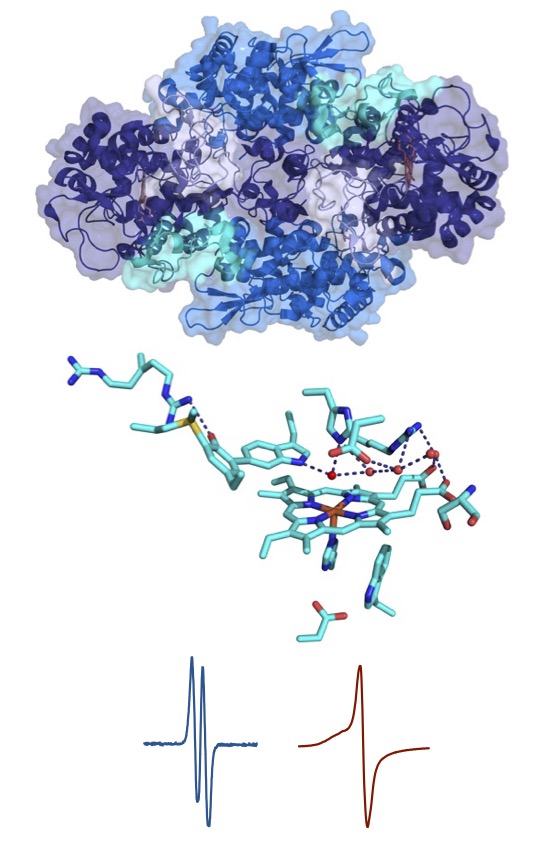
1) the multifunctional heme enzyme known as KatG,
2) two enzymes essential for aromatic amino acid biosynthesis, shikimate kinase and
shikimate dehydrogenase, and
3) antimicrobial compounds generated by Bacillus and Paenibacillus
biosynthetic gene clusters
RECENT PUBLICATIONS:
Basak, S., Alam, J., Goodwin, D., Harris, J., Patel, J.D., McCullough, P., and McElroy, J.S. "Detecting ACCase-targeting herbicides effect on ACCase activity utilizing a malachite green colorimetric functional assay" Weed Sci. 2022, 70, 14 - 19.
de Faria, C.F., Moreira, T., Lopes, P., Costa,
H., Krewall, J.R., Barton, C.M., Santos, S., Goodwin D.C.,
Mochado, D., Viveiros, M., Machuqueiro, M., and Martins, F.
"Designing new antitubercular isoniazid derivatives with improved
reactivity and membrane trafficking abilities. Biomed.
Pharmacother. 2021, 144, 112362.
Krewall, J.R.; Minton, L.E.; Goodwin, D.C. "KatG
structure and mechanism: Using protein-based oxidation to confront
the threats of reactive oxygen" In Bridging
Structure and Function in Mechanistic Enzymology. J.M.
Miller, Ed., 2020, American Chemical Society, Washington,
DC, pp. 83-120.
Sahrmann, P.G.; Donnan, P.H.; Merz, K.M.;
Mansoorabadi, S.O.; Goodwin, D.C. "MRP.py: A parameterizer of
post-translationally modified residues" J.
Chem. Inf. Model. 2020, 60, 4424.
Simithy, J.; Fuanta, N.R.; Alturki, M.; Hobrath,
J.V.; Wahba, A. E.; Pina, I.; Rath, J.; Hamann, M.T.; DeRuiter,
J.; Goodwin, D.C.; Calderon, A.I."Slow-binding inhibition of Mycobacterium
tuberculosis shikimate kinase by manzamine alkaloids" Biochemistry
2018, 57,
4923.
Simithy, J.; Fuanta, N.R.; Kochanowska-Karamayan,
A.; Hobrath, J.V.; Hamann, M.T.; Goodwin, D.C.; Calderon, A.I.
"Mechanism of irreversible inhibition of Mycobacterium
tuberculosis shikimate kinase by ilimaquinone" Biochim.
Biophys. Acta 2018, 1866, 731.
Alturki, M.S.; Fuanta, N.R.; Jarrard, M.A.; Hobrath, J.V.; Goodwin, D.C.; Rants'o, T.A.; Calderon, A.I. "A multifaceted approach to identify non-specific enzyme inhibition: Application to Mycobacterium tuberculosis shikimate kinase" Bioorg. Medicin. Chem. Lett. 2018, 28, 802.
Njuma, O.J.; Davis, I.; Ndontsa, E.N.; Krewall,
J.R.; Liu, A.; Goodwin, D.C. "Mutual synergy between catalase and
peroxidase activities of the bifunctional enzyme KatG is
facilitated by electron-hole hopping within the enzyme" J. Biol.
Chem. 2017, 292, 18408.
McCarty, S.E.; Schellenberger, A.; Goodwin, D.C.;
Fuanta, N.R.; Tekwani, B.L.; Calderon, A.I. "Plasmodium
falciparum thioredoxin reductase (PfTrxR) and its role as a
target for new antimalarial discovery" Molecules 2015,
20, 11459.
Gordon, S.; Simithy, J.; Goodwin, D.C.; Calderon,
A.I. "Selective Mycobacterium tuberculosis shikimate
kinase inhibitors as potential antibacterials" Perspect.
Medicin. Chem. 2015, 7, 9.
Huang, J.; Smith, F., Panizzi, J.R.; Goodwin,
D.C.; Panizzi, P. "Inactivation of myeloperoxidase by benzoic acid
hydrazide" Arch. Biochem. Biophys. 2015, 570,
14.
Kudalkar, S.N.; Njuma, O.J.; Li, Y.; Muldowney,
M.; Fuanta, N.R.; Goodwin, D.C. "A role for catalase-peroxidase
large loop 2 revealed by deletion mutagenesis: Control of active
site water and ferric enzyme reactivity" Biochemistry 2015,
54, 1648.
Simithy, J.; Gill, G.; Wang, Y.; Goodwin, D.C.;
Calderon, A.I. "Development of an ESI-LC-MS based assay for
kinetic evaluation of M. tuberculosis shikimate kinase" Anal.
Chem. 2015, 87, 2129.
Njuma, O.J.; Ndontsa, E.N.; Goodwin, D.C. "Catalase in peroxidase clothing: Interdependent cooperation of two cofactors in the catalytic versatility of KatG" Arch. Biochem. Biophys. 2014, 544, 27.
Wang, Y.; Goodwin D.C. "Integral role of
the I'-helix in the function of the "inactive" C-terminal domain
of catalase-peroxidase (KatG)" Biochim.
Biophys. Acta 2013,
1834, 362.
Kudalkar, S.N.; Campbell, R.A.; Li, Y.; Varnado, C.L.; Prescott, C.; Goodwin, D.C. "Enhancing the peroxidatic activity of KatG by deletion mutagenesis" J. Inorg. Biochem. 2012, 116, 106.
Ndontsa, E.N.; Moore, R.L.; Goodwin, D.C.
"Stimulation of KatG catalase activity by peroxidatic electron
donors" Arch. Biochem.
Biophys. 2012, 105,
215.
Tejero, J.; Biswas, A.; Haque, M.M.; Wang, Z.Q.; Hemann, C.; Varnado, C.L.; Novince, Z.; Hille, R.; Goodwin, D.C.; Stuehr, D.J. "Mesohaem substitution reveals how haem electronic properties can influence the kinetic and catalytic parameters of neuronal NO synthase" Biochem. J. 2011, 433, 163.
You can view a listing of all our publications
here.