MACROCAT INTERMEDIATE
MACROECONOMICS
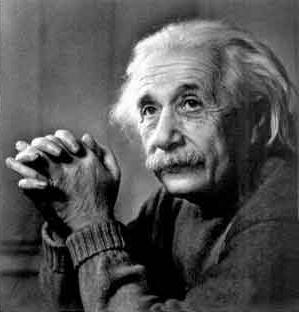
Purpose and Scope of the Course: Guided by the text and the materials available through the course website, the lectures will develop the analytical tools needed to deal with such issues as unemployment, inflation, business cycles, and economic growth. An effort will be made to strike a balance between acquiring technical skills and achieving economic understanding. After completing the course, students should have a solid grasp of the several competing macroeconomic frameworks and of the nature and causes of the current macroeconomic malaise. They should be able to identify the many fallacies in the following passage, which inspird by John Maynard Keynes but was actually penned (in 1934) by Albert Einstein:
 Synopsis
and Stocktaking: The course
begins
with the ideas that existed prior to the publication of John Maynard
Keynes's General Theory of Employment, Interest, and Money
(1936)
and traces the macroeconomics that has evolved out of the Keynesian
Revolution. Synopsis
and Stocktaking: The course
begins
with the ideas that existed prior to the publication of John Maynard
Keynes's General Theory of Employment, Interest, and Money
(1936)
and traces the macroeconomics that has evolved out of the Keynesian
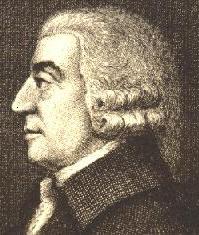
Revolution. Classical economics, which dates from Adam Smith's Wealth of Nations (1776), reflects the summary judgment that markets work and that market-economies grow–implying a policy recommendation of laissez faire. It is this judgment that Keynes called into question and that lies at the root of modern debate. Is there a market mechanism that coordinates economic activities over time? More pointedly, does saving today get translated into investment for the future? The Austrian economists, particularly F. A. Hayek, focused attention on the rate of interest and showed how intertemporal coordination is (or, at least, can possibly be) achieved in a market economy. Keynes rejected the classical and Austrian views and made the summary judgment that the saving-cum-investment nexus of the market economy is failure-prone. The perceived absence of vital market mechanisms caused him to recommend policy activism as an alternative means of securing full employment. 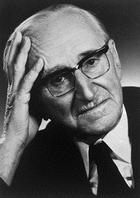 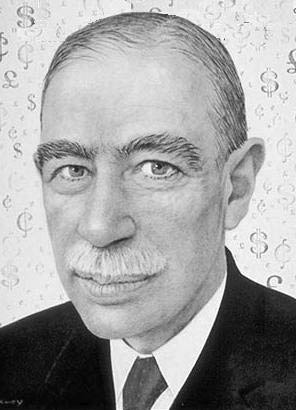 The simplest Keynesian model (Y = C + I + G)* ignores both
interest-rate
and price-level considerations; the extended models (ISLM** and
AggS/AggD***)
incorporate interest-rate effects (ISLM) and both interest-rate and
price-level
effects (AggS/AggD). All the Keynesian constructions reflect the notion
that
some markets (for goods, for labor, and/or for loanable funds) fail to
work––or work
perversely or work
too sluggishly––to maintain full employment.
The simplest Keynesian model (Y = C + I + G)* ignores both
interest-rate
and price-level considerations; the extended models (ISLM** and
AggS/AggD***)
incorporate interest-rate effects (ISLM) and both interest-rate and
price-level
effects (AggS/AggD). All the Keynesian constructions reflect the notion
that
some markets (for goods, for labor, and/or for loanable funds) fail to
work––or work
perversely or work
too sluggishly––to maintain full employment. A quarter of a century after the publication of Keynes's General Theory, a trumped-up classical model was introduced into macroeconomic textbooks. This model, which no know classical economist ever endorsed, either ignores the saving-cum-investment coordination mechanism or fails to integrate that mechanism into the classical framework. But the relevance and plausibility of this model rests on the implicit assumption that the market has no problem in translating saving into investment.  In addition to
Keynesianism,
Austrianism, and Classicism, other schools of thought––Monetarism
(Milton
Friedman),
In addition to
Keynesianism,
Austrianism, and Classicism, other schools of thought––Monetarism
(Milton
Friedman), New Classicism (Robert Lucas), Real Business Cycle Theory (Edward Prescott) and New Keynesianism (Gregory Mankiw)––will be considered. By the end of the term, the student should have a good understanding of the core of ideas that unite the various schools of thought as well as the major issues that separate them.
**In ISLM analysis, equilibrium is achieved when Investment (I) equals Saving (S) and the Demand for Money (L) equals the Supply of Money (M). ***In AggS/AggD analysis, equilibrium is achieved when Aggregate Supply equals Aggregate Demand, where AggS and AggD are each conceived as a relationship between income (Y) and the price level (P). The logical integrety of this construction is threatened by tha fact that the two P-Y relationships (underlying AggD and AggS) are based on different–and conflicting–assumptions about the way a market economy functions. Class Participation: Student participation is encouraged and welcomed. Questions for the purpose of clarification will benefit most all the students; critical questions and comments tend to make the course more interesting. Organization, Readings, and Exam
Schedule:
The reading material is divided into three lecture series as shown in
the
table below. The table includes reading assignments from Richard T.
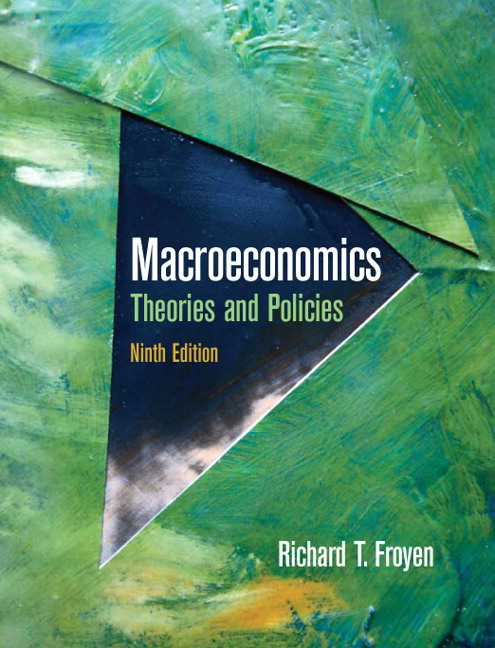
Froyen's Macroeconomics: Theories and Policies, 9th edition, as
well as readings available through this site. The
scheduling of the textbook chapters may be modified as the course
progresses. Also, additional readings may be assigned as appropriate.
The subject matter covered in class will parallel the assigned reading, but in some instances the lectures will go beyond the text. Thus, the text and the lectures should be viewed as complements and not as substitutes. The analytics of macroeconomic phenomena will be the primary focus of the lectures. The Handouts, Readings, PowerPoint files, and Links available through this web site should be helpful. The Handouts summerize some of the key concepts discussed in class and give the students a preview of test material. The Readings reinforce and elaborate upon the ideas presented in the text. The PowerPoint files are the ones shown in class and are made available here for reinforcement and review. The Links are intended to anchor class material to some of the institutions, policy actions, and macroeconomic data being discussed. Examinations: There will be two one-hour exams (scheduled for September 29 and October 27) and a comprehensive final exam as scheduled by the university (December 8, 12:00 - 2:30 p.m.). The exams will be constructed in a multiple-choice format but some questions will require a graphical and/or algebraic solution. The wearing of caps, hats, bonnets, sombreros, motorcycle helmets, ski masks or other headgear is not allowed during the exam. Grading System: One-fourth
of your course grade is based on
attendance. Each student begins the course with 100 attendance points.
Then, beginning on Monday, August 23, he or she will lose three points
for
each
unexcused absence. Late-arriving students can be counted as absent at
the discretion of the professor. The three exams will count 100 points
each, which means that the total possible points in the course (exams
plus attendance) is 400.
Hence, if a student has four
unexcused absences (for an attendance score of 88) and has exam scores
of 76, 85, and 79, his or her course average would be (88 + 76 + 85 +
79)/4 =
83. Letter
grades for the course will be determined by applying a 10-point scale
to
the course average. That is, 90 and above is an A; 80 to 90 is a
B; etc. Make-ups: Students will not be permitted to take the exams early or late. Should it become necessary for a student to miss an exam, he or she should notify the instructor in advance of the exam date. Students with excused absences will be required to take a make-up exam as arranged by the professor. Supplemental Materials:
Advanced Reading--optional Roger W.
Garrison, Time
and
Money: The Macroeconomics of Capital Structure, London:
Routledge,
2001
|
 Only
a fraction of the available human labor in the world is now needed for
the production of the total amount of consumption goods necessary to
life.
Under a complete laissez-faire economic system, this fact is bound to
lead
to unemployment. ... This leads to a fall in sales and profits.
Businesses
go bust, which further increases unemployment and diminishes confidence
in industrial concerns and therewith public participation in the
mediating
banks; finally the banks become insolvent through the sudden withdrawal
of accounts and the wheels of industry therewith come to a complete
standstill....
If we could manage to prevent the purchasing power of the masses,
measured
in terms of goods, from sinking below a certain minimum, stoppages in
the
industrial cycle such as we are experiencing today [1934] would be
rendered
impossible. The logically simplest but most daring method of achieving
this is a completely planned economy, in which consumption goods are
produced
and distributed by the community.
Only
a fraction of the available human labor in the world is now needed for
the production of the total amount of consumption goods necessary to
life.
Under a complete laissez-faire economic system, this fact is bound to
lead
to unemployment. ... This leads to a fall in sales and profits.
Businesses
go bust, which further increases unemployment and diminishes confidence
in industrial concerns and therewith public participation in the
mediating
banks; finally the banks become insolvent through the sudden withdrawal
of accounts and the wheels of industry therewith come to a complete
standstill....
If we could manage to prevent the purchasing power of the masses,
measured
in terms of goods, from sinking below a certain minimum, stoppages in
the
industrial cycle such as we are experiencing today [1934] would be
rendered
impossible. The logically simplest but most daring method of achieving
this is a completely planned economy, in which consumption goods are
produced
and distributed by the community.