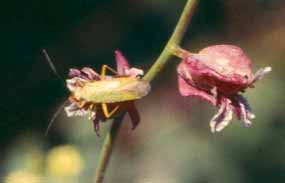
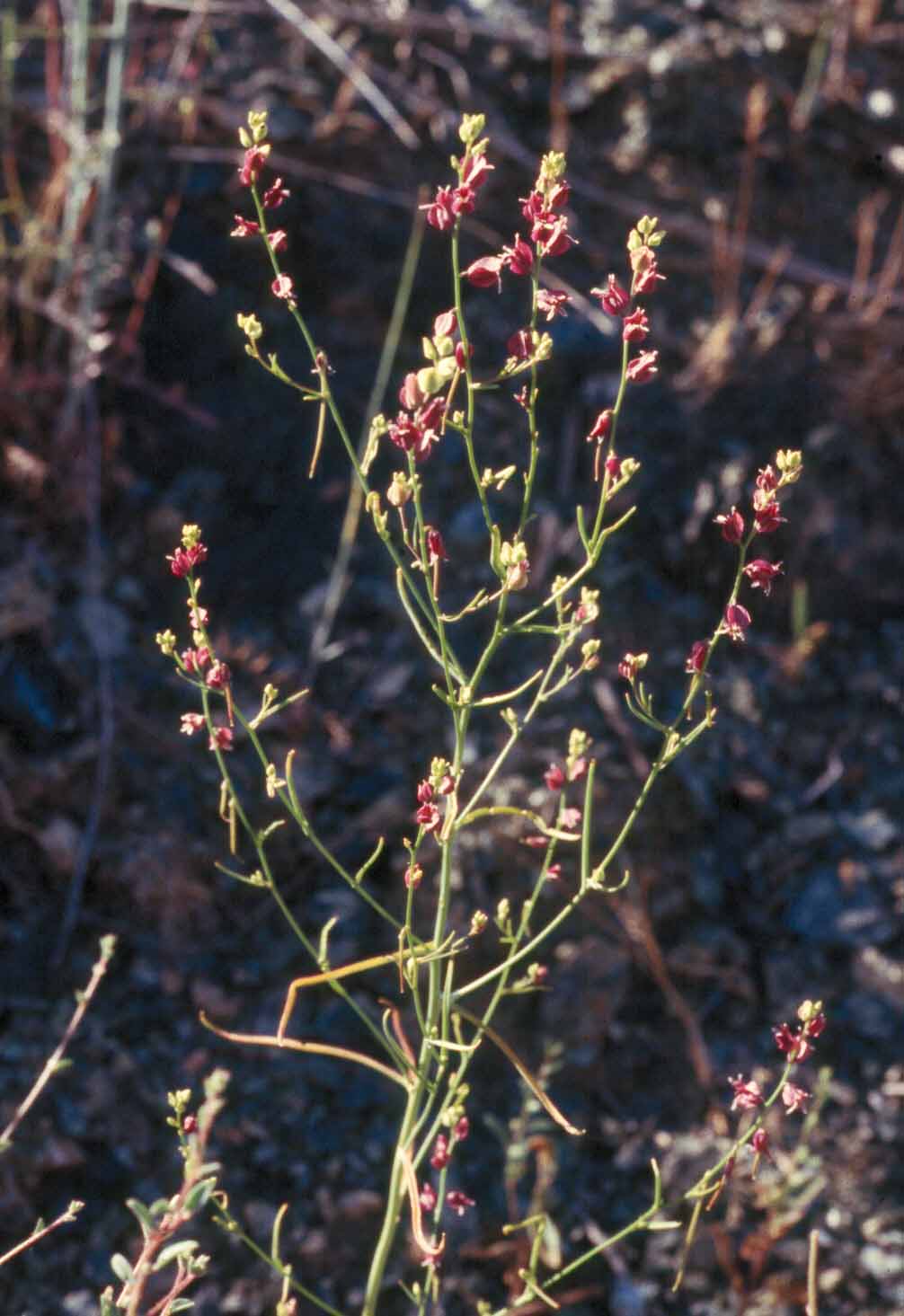
Streptanthus
polygaloides, a Ni hyperaccumulator endemic to California's Sierra
Nevada
International Conferences
on Serpentine Ecology
Every several years since 1991, an international group of
botanists/geologists/ecologists has gathered to discuss the ecology of
serpentine (ultramafic) areas. The first conference was at the
University of California, Davis, the second in Noumea, New Caledonia,
the third at Kruger National Park in South Africa, the fourth at
the National Botanical Garden in Havana, Cuba, the fifth in Siena,
Italy, the sixth in Bar Harbor, Maine, the seventh in Coimbra Portugal, and the last in Kota Kinabalu, Malaysia
in 2014. Besides
the presentation
of papers and posters, the conferences feature field trips to local
ultramafic locations.
The next is
planned for Albania in June 2017.
Conservation Biology
We are also interested in several areas loosely grouped here under
Conservation Biology. Several students and I have conducted studies of
rare and (sometimes) endangered plant species. These studies include
geographic and population surveys, studies of population biology, and
exporation of management techniques (mowing, burning, etc.).
We have also
collaborated
on more broad projects. We completed a 5+ year study of
coastal dune restoration techniques at Bon Secour National Wildlife
Refuge in southern Alabama. This project examined responses to
these techniques of both the vegetation and the federally endangered
Alabama beach mouse (collaboration with Dr. Mike Wooten of my
department). We also set up a long-term study of restoration
techniques for mountain longleaf pine stands in the Talladega National
Forest (Alabama), working with Dr. Les Goertzen and Curtis Hansen of
AU's John D. Freeman Herbarium.
Graduate Students
COMPLETED
">Kyle Paris,
M.S. 2013 Population status and reproductive biology of (Clematis
morefieldii,
a federally endangered plant.
- Dorothy
Cheruiyot, Ph.D. 2012. Invesigation of elemental defense and trophic
transfer of metals using beet armyworm, Spodoptera exigua, Hubner.
- M. Scott Wiggers, M.S.
2011. Some like it
hot: Fire and legume germination in the longleaf pine ecosystem. (co-advised with Dr. Kay Kirkman
of the Jones Research Center in Ichauway, GA).
- Denise Adkison, M.S.
Non-Thesis. 2011.
- James Mincy Moffett,
Jr, Ph.D. 2008. Ecology and management of the
federally endangered plant, Xyris
tennesseensis (Xyridaceae).
- Alvin Diamond, Ph.D.
2005. Ecology of Rudbeckia auriculata (Asteraceae),
a rare southeastern endemic.
- Edward Jhee,
Ph.D. 2004. Hyperaccumulation of nickel by Streptanthus polygaloides
(Brassicaceae): Implications for elemental defense.
- Micheal Davis,
Ph.D. 1999. Characterization of the metal-based defense of
Ni-hyperaccumulating plants.
- Michael Wall, M.S.
1999. Nickel accumulation in serpentine arthropods with emphasis
on Melanotrichus boydi (Heteroptera:
Miridae).
- Patrick Murphy, M.S.
1997. Population status and ecology of the endangered Alabama
canebrake pitcher plant (Sarracenia
rubra subspecies alabamensis).
- Greg Creech, M.S. 1995.
Population biology of Cakile
constricta (Cruciferae) at Phillips Inlet Beach, Florida.
- Jarel Hilton, M.S.
1993. Aspects of the ecology and life history of the granite pool
sprite, Amphianthus pusillus
Torrey (Scrophulariaceae).
- Margaret Erskine, M.S.
1992. Reproductive ecology of Clematis
socialis.
CURRENT
- Katherine Mincey,
Ph.D. Ecological investigations of the nickel hyperaccumulator Streptanthus polygaloides.
Undergraduate
Student Theses
- Christina Coleman,
Honors Thesis. 2004. Extending the elemental defense hypothesis: metals
may protect plants from herbivores at accumulator and hyperaccumulator
concentrations.
Alabama Plant Conservation Alliance
I serve as Coordinator of the Alabama Plant
Conservation Alliance (APCA), a statewide consortium of plant-oriented
groups and individuals committed to conservation of native Alabama
plants begun in late 2008. Please check out the website for our group
that contains information on our active projects, meeting minutes, and
other information. Or, check our
APCA Facebook page!
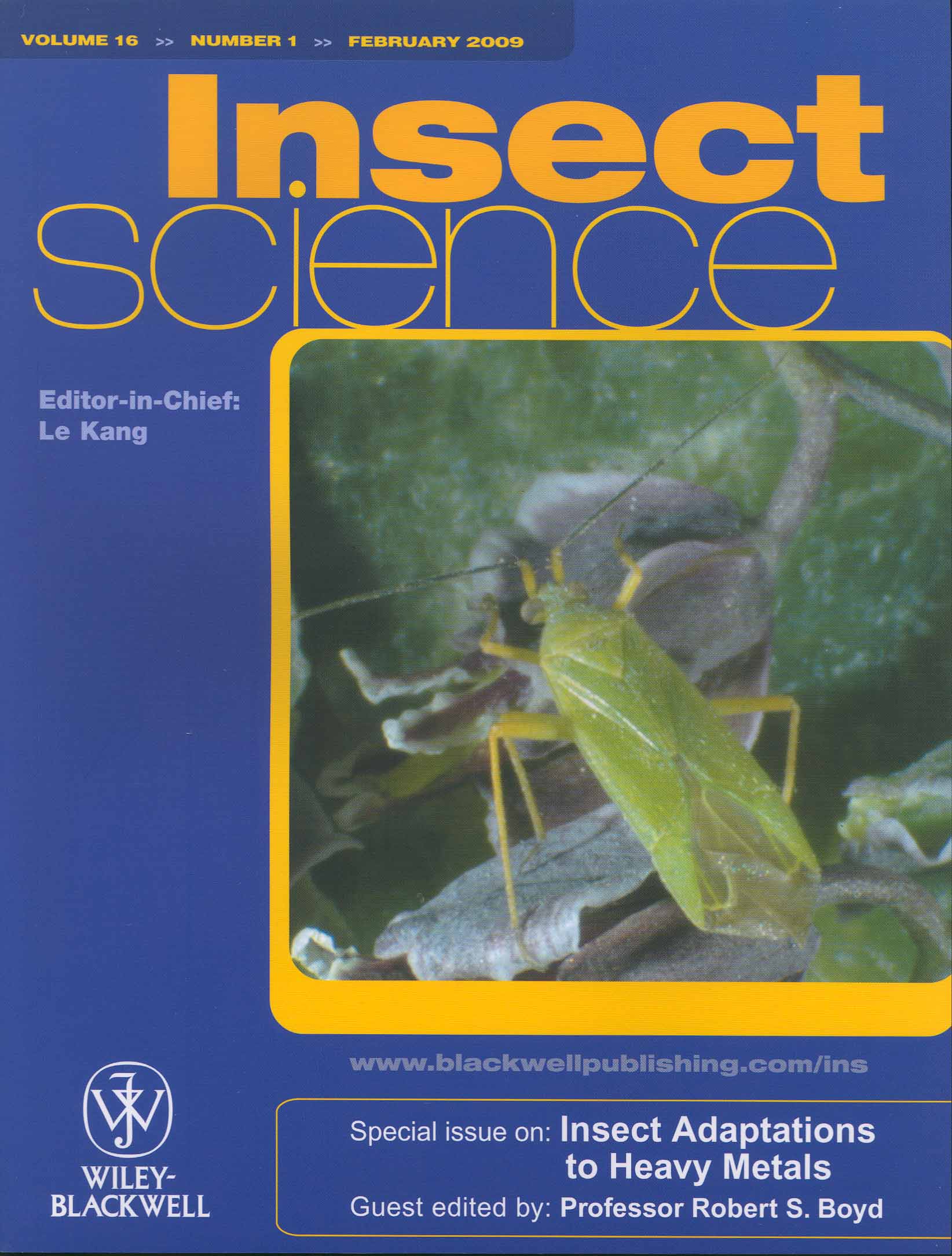
Guest Editor: Insect Science Special Issue "Insect Adaptations to
Heavy Metals" Volume 16, No. 1, Feb. 2009
Edited Book:
Ultramafic Ecology
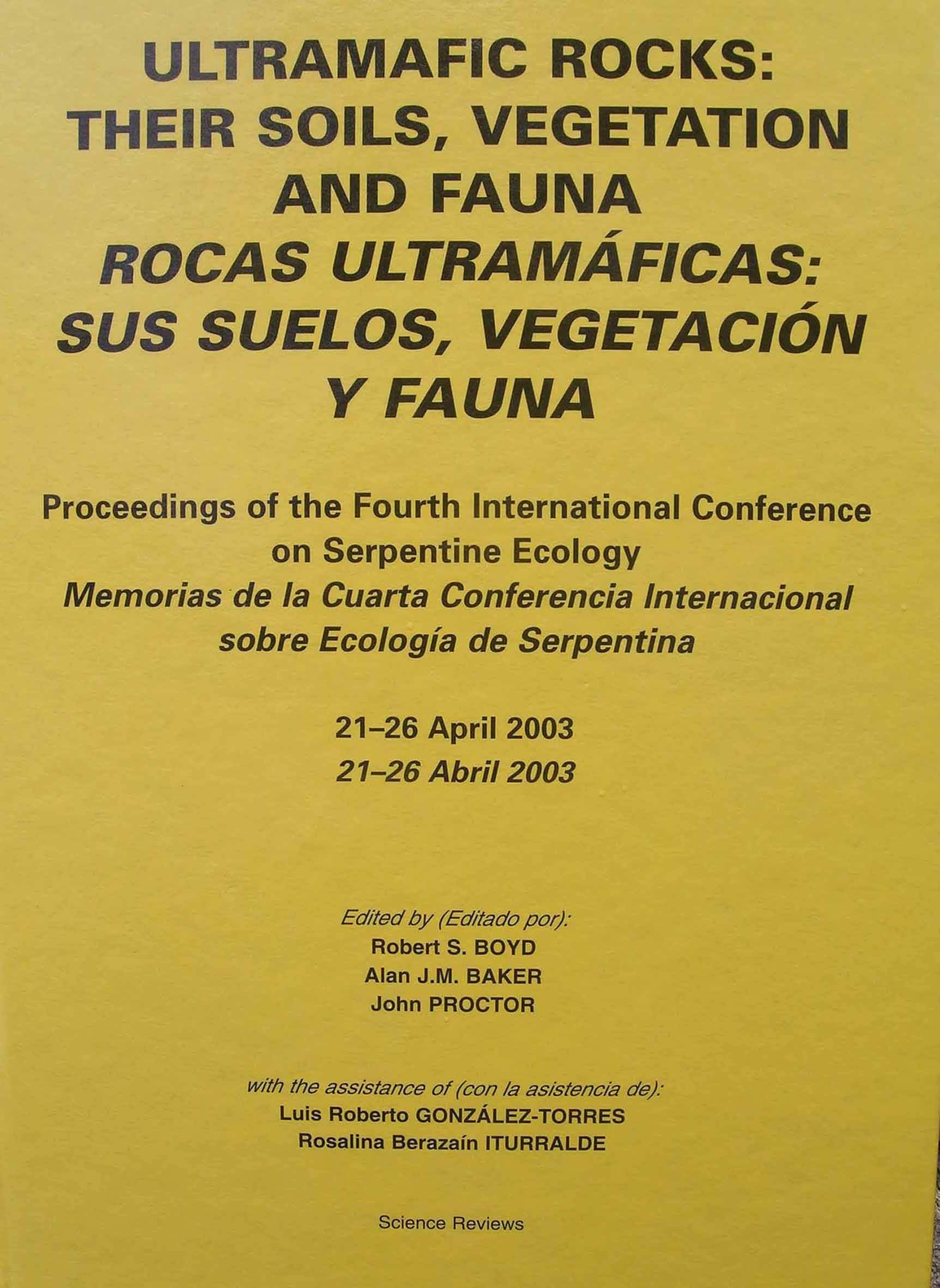
-
Boyd RS, AJM Baker,
and J Proctor. 2004. Ultramafic rocks: their soils, vegetation and
fauna. Science Reviews 2000 Ltd, St Albans, Herts,
UK. Hardcover, with full color photos! Want to order a copy? Download order form
here!
Publications:
Hyperaccumulation
- Boyd, R.S. 2012. Plant defense using toxic
inorganic ions: Conceptual models of the Defensive Enhancement and
Joint Effects Hypotheses. Plant Science 195:88-95. (pdf)
- Boyd, R. 2010. Elemental defenses of plants by
metals. Nature Education Knowledge 1(8):6. (Link)
- Boyd, R.S. 2010. Heavy metal pollutants and chemical
ecology: exploring new frontiers. Journal of Chemical Ecology 36:46-58.
(pdf)
- Boyd, R.S. 2009. High-nickel insects
and
nickel hyperaccumulator plants: A review. Insect Science 16:19-31. (pdf)
- Boyd, R.S., A.R. Kruckeberg and N. Rajakaruna.
2009. Biology of ultramafic rocks and soils: Research goals for the
future. Northeastern Naturalist 16:422-440. (pdf)
- Boyd, R.S., M.A. Wall, S.R. Santos and M.A. Davis. 2009.
Variation of morphology and elemental concentrations in the California
nickel hyperaccumulator Streptanthus polygaloides (Brassicaceae).
Northeastern Naturalist 16:21-38. (pdf)
- Rajakaruna, N. and R.S. Boyd. 2009. Advances in serpentine
geoecology: a retrospective. Northeastern Naturalist 16:1-7. (pdf)
- Boyd, R.S., M.A. Wall and T. Jaffré. 2009. Do
tropical nickel hyperaccumulators mobilize metals into epiphytes? A
test using bryophytes from New Caledonia. Northeastern Naturalist
16:139-154. (pdf)
- Boyd, R.S. and T. Jaffré. 2009. Elemental
concentrations of eleven New Caledonian plant species from serpentine
soils: Elemental correlations and leaf age effects. Northeastern
Naturalist 16:93-110. (pdf)
- Boyd, R.S., M.A. Davis, M.A. Wall and K. Balkwill. 2009.
Host plant-herbivore studies on Chrysolina
clathrata (Clark) (Coleoptera: Chrysomelidae) from Mpumalanga,
South Africa. Insect Science 16:81-88. (pdf)
- Rajakaruna, N. and R.S. Boyd. 2008. Edaphic Factor. Pp.
1201-1207, In: S.E. Jorgensen and B.D. Fath (Editors-in-Chief), General
Ecology. Volume 2 of Encyclopedia of Ecology (5 volumes). Elsevier
Science, Amsterdam, The Netherlands.
- Boyd, R.S., M.A. Davis and K. Balkwill. 2008. Does
hyperaccumulated nickel affect leaf decomposition? A field test using Senecio coronatus (Asteraceae) in
South Africa. Chemoecology 18:1-9. (pdf)
- Boyd, R.S., M.A.
Davis and K.
Balkwill. 2008. Elemental patterns in Ni hyperaccumulating and
non-hyperaccumulating ultramafic soil populations of Senecio coronatus. South African
Journal of Botany 74:158-162.
- Boyd, R.S. 2007. Lygus
hesperus
(Heteroptera: Miridae) tolerates high concentrations of dietary nickel.
Insect Science 14:201-205. (pdf)
- Boyd, R.S. 2007. The defense hypothesis of elemental
hyperaccumulation: status, challenges and new directions. Plant and
Soil 293:153-176. (pdf)
- Boyd, R.S., M.A. Davis, M.A. Wall and K. Balkwill. 2007.
Host-herbivore studies of Stenoscepa
sp. (Orthoptera: Pyrgomorphidae), a high-Ni herbivore of the South
African Ni hyperaccumulator Berkheya
coddii (Asteraceae). Insect Science 14:133-143. (pdf)
- Wall, M.A. and R.S. Boyd. 2006. Melanotrichus boydi (Heteroptera:
Miridae) is a specialist on the nickel hyperaccumulator Streptanthus polygaloides
(Brassicaceae). Southwestern Naturalist 51:481-489. (pdf)
- Boyd, R.S., M.A. Wall, T. Jaffré. 2006. Nickel levels
in arthropods associated with Ni hyperaccumulator plants from an
ultramafic site in New Caledonia. Insect Science 13:271-277. (pdf)
- Boyd, R.S., M.A. Davis, M.A. Wall and K. Balkwill. 2006.
Metal concentrations of insects associated with the South African Ni
hyperaccumulator Berkheya coddii
(Asteraceae). Insect Science 13:85-102. (pdf)
- Jhee, E.M., R.S. Boyd and M.D. Eubanks. 2006.
Effectiveness
of metal-metal and metal-organic compound combinations against Plutella xylostella (Lepidoptera:
Plutellidae): Implications for plant elemental defense. Journal of
Chemical Ecology 32:239-259. (pdf)
- Jhee, E.M., R.S. Boyd, M.D. Eubanks and M.A. Davis. 2005.
Nickel
hyperaccumulation by Streptanthus
polygaloides protects against the
folivore Plutella xylostella
(Lepidoptera: Plutellidae). Plant Ecology 183:91-104. (pdf)
- Jhee, E.M., R.S. Boyd and M.D. Eubanks. 2005. Nickel
hyperaccumulation
as an elemental defence of Streptanthus
polygaloides (Brassicaceae):
influence of herbivore feeding mode. New Phytologist 168:331-344. (pdf)
- Boyd, R.S. and E.M. Jhee. 2005. A test of elemental defence
against
slugs by Ni in hyperaccumulator and non-hyperaccumulator Streptanthus
species. Chemoecology 15:179-185. (pdf)
- Coleman, C.M., R.S. Boyd and M.D. Eubanks. 2005. Extending
the
elemental defense hypothesis: dietary metal concentrations below
hyperaccumulator levels could harm herbivores. Journal of Chemical
Ecology 31:1669-1681. (pdf)
- Boyd, R.S. 2004. Ecology of metal hyperaccumulation. New
Phytologist 162:563-567. (pdf)
- Wall, M.A. and R.S. Boyd. 2002. Nickel
accumulation in
serpentine arthropods from the Red Hills, California. Pan-Pacific
Entomologist 78: 168-176.
- Boyd, R.S., M.A. Davis, M.A. Wall and K. Balkwill.
2002. Nickel
defends the South African hyperaccumulator Senecio coronatus
(Asteraceae) against Helix aspersa
(Mollusca: Pulmonidae). Chemoecology
12:91-97. (pdf)
- Boyd, R.S. 2002. Does elevated body Ni
concentration
protect insects against pathogens? A test using Melanotrichus boydi
(Heteroptera: Miridae). American Midland Naturalist 147:225-236. (pdf)
- Martens, S.N. and R.S. Boyd. 2002. The defensive
role of Ni
hyperaccumulation by plants: a field experiment. American Journal of
Botany 89:998-1003. (pdf)
- Davis, M.A., R.S. Boyd, and J.H. Cane. 2001.
Host-switching does
not circumvent the Ni-based defence of the Ni hyperaccumulator Streptanthus polygaloides
(Brassicaceae). South African Journal
of Science 97:554-557. (pdf)
- Boyd, R.S. and T. Jaffré. 2001.
Phytoenrichment
of soil Ni concentration by Sebertia
acuminata in New Caledonia and the
concept of elemental allelopathy. South African Journal of
Science 97:535-538. (pdf)
- Boyd, R.S. and M.A. Davis. 2001. Metal tolerance
and
accumulation ability of the Ni hyperaccumulator Streptanthus polygaloides Gray
(Brassicaceae). International Journal of Phytoremediation
3:353-367.
- Boyd, R.S. and M.A. Wall. 2001. Responses of
generalist
predators fed high-Ni Melanotrichus
boydi (Heteroptera: Miridae): Elemental defense against the
third trophic level. American Midland Naturalist 146:186-198. (pdf)
- Davis, M.A., S.G. Pritchard, R.S. Boyd, and S.A.
Prior.
2001. Developmental and induced responses of nickel-based and
organic defences of the nickel-hyperaccumulating shrub, Psychotria
douarrei. New Phytologist 150:49-58. (pdf)
Davis, M.A., J.F. Murphy and R.S. Boyd. 2001. Nickel
increases
susceptibility of a Ni hyperaccumulator to Turnip mosaic virus.
Journal of Environmental Quality 30:85-90. (pdf)
- Boyd, R.S., M.A. Wall, and J.E. Watkins, Jr.
2000.
Correspondence between Ni tolerance and hyperaccumulation in Streptanthus
(Brassicaceae). Madroño 47:97-105.
- Davis, M.A. and R.S. Boyd. 2000. Dynamics of
Ni-based
defence and organic defences in the Ni hyperaccumulator, Streptanthus
polygaloides Gray (Brassicaceae). New Phytologist
146:211-217. (pdf)
- Boyd, R.S., S.N. Martens, and M.A. Davis. 1999.
The Ni
hyperaccumulator Streptanthus
polygaloides (Brassicaceae) is attacked
by the parasitic plant Cuscuta
californica (Cuscutaceae).
Madroño 46:92-99.
- Boyd, R.S., T. Jaffré, and J.W. Odom. 1999.
Variation of
nickel content in the nickel-hyperaccumulating shrub Psychotria
douarrei (Rubiaceae) from New Caledonia. Biotropica
31:403-410.
- Boyd, R.S. and S.N. Martens. 1999. Aphids are
unaffected by
the elemental defense of the nickel hyperaccumulator Streptanthus
polygaloides (Brassicaceae). Chemoecology 9:1-7. (pdf)
- Boyd, R.S. and W.J. Moar. 1999. The defensive
function of
Ni in plants: response of the polyphagous herbivore Spodoptera exigua
(Lepidoptera: Noctuidae) to hyperaccumulator and accumulator species of
Streptanthus (Brassicaceae). Oecologia 118:218-224. (pdf)
- Boyd, R.S. and S.N. Martens. 1998. The significance of
metal
hyperaccumulation for biotic interactions. Chemoecology 8:1-7. (pdf)
- Boyd, R.S. and S.N. Martens. 1998. Nickel hyperaccumulation
by Thlaspi
montanum var. montanum
(Brassicaceae): a constitutive trait. American
Journal of Botany 85:259-265. (pdf)
- Boyd, R.S., J. Shaw, and S.N. Martens. 1994. Nickel
hyperaccumulation
defends Streptanthus polygaloides
(Brassicaceae) against pathogens.
American Journal of Botany 81:194-300.
- Boyd, R.S. and S.N. Martens. 1994. Nickel hyperaccumulated
by Thlaspi
montanum var. monantum
is acutely toxic to an insect herbivore. Oikos
70:21-25.
- Martens, S.N. and R.S. Boyd. 1994. The ecological
significance of
nickel hyperaccumulation: a plant chemical defense. Oecologia
98:379-384.
Publications:
Conservation Biology
- Boyd, R.S., A. Teem and M.A. Wall. 2011. Floral biology of
an Alabama population of the federally endangered plant, Xyris tennesseensis Kral
(Xyridaceae). Castanea 76:255-265.
- Goertzen, L.R., J.L. Trusty and R.S. Boyd. 2011. Clonal
diversity and structure in the endangered Alabama leather flower Clematis socialis Kral
(Ranunculaceae). Journal of the Torrey Botanical Society 138:41-51
- Trusty, J.L., I. Miller, V.C. Pence, B.L. Blair, R.S. Boyd
and L.R. Goertzen. 2009. Ex situ conservation of the federally
endangered plant species Clematis
socialis Kral (Ranunculaceae). Natural Areas Journal 29:376-384.
- Goertzen, L.R. and R.S. Boyd. 2007. Genetic diversity and
clonality in the federally endangered plant Clematis socialis Kral
(Ranunculaceae). Journal of the Torrey Botanical Society 134:433-440. (pdf)
- Boyd, R.S. 2007. Response to fire of Ceanothus roderickii (Rhamnaceae),
a federally endangered California endemic shrub. Madroño
54:13-21.
- Diamond, A.R., Jr., H. El Mayas and R.S. Boyd. 2006. Rudbeckia auriculata infected with
a pollen mimic fungus in Alabama. Southeastern Naturalist 5:103-112.
- Diamond, A.R., Jr., D.R. Folkerts and R.S. Boyd. 2006.
Pollination biology, seed dispersal and recruitment in Rudbeckia auriculata (Perdue) Kral,
a rare southeastern endemic. Castanea 71:226-238.
- Diamond, A.R., Jr. and R.S. Boyd. 2004. Distribution,
habitat
characteristics, and population trends of the rare southeastern endemic
Rudbeckia auriculata (Perdue)
Kral (Asteraceae). Castanea 69:249-264. (pdf)
- Boyd, R.S. 2003. Factors affecting seed production by the
endangered
chaparral shrub Fremontodendron
decumbens subsp. decumbens
(Sterculiaceae). Madroño 50:232-242.
- Wall, M.A., M. Timmerman-Erskine and R.S. Boyd.
2003.
Conservation impact of climatic variability on pollination of the
federally endangered plant, Clematis
socialis Kral (Ranunculaceae).
Southeastern Naturalist 2:11-24. (pdf)
- Timmerman-Erksine, M., J. Ballenger, R.R. Dute and R.S.
Boyd.
2003. Isozyme investigation of the Trillium
pusillum Michaux
complex (Trilliaceae): Taxonomic and conservation implications.
Journal of the Torrey Botanical Society 130:1-10.
- Timmerman-Erksine, M., R.R. Dute and R.S. Boyd.
2002.
Morphometric analysis of the Trillium
pusillum Michaux complex
(Trilliaceae) of the southeastern United States. Castanea
67:109-119.
- Timmerman-Erksine, M., R.R. Dute and R.S. Boyd.
2002. The Trillium pusillum
Michaux
complex (Trilliaceae): Analysis of pollen and
leaf epidermal micromorphology. Journal of the Torrey Botanical Society
129:175-186.
- Wall, M.A., A.P. Teem and R.S. Boyd. 2002. Floral
manipulation by Lasioglossum zephyrum
(Hymenoptera: Halictidae) ensures
first access to floral rewards by initiating premature anthesis of Xyris tennesseensis
(Xyridaceae) flowers. Florida Entomologist
85:290-291. (pdf)
- Boyd, R.S. 2001. Ecological benefits of
myrmecochory for
the endangered chaparral shrub Fremontodendron
decumbens
(Sterculiaceae). American Journal of Botany 88:234-241. (pdf)
- Miller, J.H., R.S. Boyd, and M.B. Edwards. 1999.
Residual effects
of forestry herbicides on floristic diversity, stand structure and
composition eleven years after site preparation treatments. Canadian
Journal of Forest Research 29:1073-1083.
- Timmerman-Erskine, M. and R.S.
Boyd. 1999. Reproductive biology of the endangered plant Clematis socialis
(Ranunculaceae). Journal of the Torrey Botanical Society
126:107-116.
- Murphy, P.B. and R.S. Boyd.
1999. Population status and habitat
characterization of the endangered plant, Sarracenia rubra subspecies
alabamensis. Castanea 64:101-113.
- Hilton, J.L. and R.S. Boyd. 1996.
Microhabitat
requirements and
seed/microsite limitation of the rare granite outcrop endemic Amphianthus pusillus.
Bulletin of the Torrey Botanical Club 123:189-196.
- Boyd, R.S. 1996. Ant-mediated seed dispersal of the rare
chaparral
shrub Fremontodendon decumbens
(Sterculiaceae). Madroño
43:299-315.
- Boyd, R.S., J.D. Freeman, J.H. Miller, and M.B. Edwards.
1995. Forest
herbicide influences on floristic diversity seven years after broadcast
pine release treatments in central Georgia, USA. New Forests 10:17-37.
- Boyd, R.S. and C.D. Hilton. 1994. Ecologic studies of the
endangered
species Clematis socialis
Kral. Castanea 59:31-40.
- Boyd, R.S., R.A. Woodward and G. Walter. 1994. Fire effects
on a
montane Sierra Nevada meadow. California Fish and Game 79:115-125
- Boyd, R.S. 1994. Pollination biology of the rare shrub Fremontodendron
decumbens (Sterculiaceae). Madroño 41:277-289.
- Boyd, R.S. and L.L. Serafini. 1992. Reproductive attrition
in the rare
chaparral shrub Fremontodendron
decumbens Lloyd (Sterculiaceae).
American Journal of Botany 79:1264-1272.
Educational
Publication
- Lishak, E. Wester, J. Dobie, J. Armbruster, R. Boyd, D. Folkerts,
and C. Guyer. 2001. Survey of Life, Biology 1010. Contemporary
Publishing of Raleigh, Raleigh.
Back to the FACULTY
page.