Office hours for Spring Semester 2019 (January 9 to
April 26)
Tuesday & Thursday, 7-7:40 a.m.; 11 a.m.-noon; Wednesdays 8-10 a.m. AND
whenever the door is open (most weekdays from 7 a.m. till early afternoon) Course prerequisite Grade of C or better
in MKTG 3310 Required Materials
There will be a book to read, and a packet of
supplemental articles that must be read, and email lecture supplements
that must be read, too. Because too many students get to their junior or
senior years of college education foolishly clinging to the mistaken idea
that copying from the screen is the same as taking notes on a class (even
though it isn't), students are required to buy the slides containing all
on-screen verbiage, thereby enabling everyone to take what should be the
important class notes that would help them remember and learn the lessons
of the class discussions. Class slides are illustrations to assist in
understanding the different elements of the course: no slides be from
publisher-provided collections will be used, no slide will be read to the
class, and no test will ask for a recitation of a list, especially not a
list shown in a slide
Specifically, Four Required Purchases
1) Advertising, MKTG 4320,
McGraw-Hill Create compilation, ISBN-10: 1-307-37765-3 This is drawn from
Belch & Belch, Advertising & Promotion, 11th edition,
2018, ISBN 1259548147. In
case anyone finds a used book that's less expensive than the compilation,
the reading assignments also provide the chapters of the original book.
This is a different book than the one used during Fall semester 2018
2) 12 Scranton #882-E (smaller sized forms) and pencils for quizzes
3) Required readings that supplement text
4) class slides
→ both (3) & (4) are sold at Sofy Copy Center, 145 E. Magnolia, &
are changed from Spring 2018
Required Online Materials - Canvas will not be used
1) Additional required reading assignments
and videos available via syllabus links in class outline below
2) University email will convey assignment updates, plus required reading
materials that include lecture supplements
3) Online discussion
questions provide most of the questions that students will be called
upon to answer during class
Important Dates In this course, "Syllabus Day" is not a thing Test #1: February 12 Test #2: March 21 American Academy of Advertising International
Conference, Dallas: March 28-31 Comprehensive final exam: There
might be a combined section final exam, and if not. . . .
8 a.m. class:
Thursday, May 2, 8-10:30 a.m. 9:30 class: Wednesday, May 1, 8-10:30
a.m.
As per university policy, the final exam will be administered at the
assigned time. An earlier test will not be granted for students wanting to
depart for jobs, job interviews, graduate school interviews, family
vacations, to assist a roommate recovering from an end-of-term bar crawl,
or to spend time with a strange woman with two hearts who stepped out of a
1960s-era blue British police box that materialized in front of your
apartment and that you discover is smaller on the outside than it is
inside. (If I have to explain this last one, never mind.)
A signed class contract is a precondition for
anyone to be considered present for class, to take any tests, or to have
scores counted for any quiz or homework
Grades will be based on point totals, not averages,
percentile scores or letter grades on each item. There might be extra credit
values from an additional quiz, or extra points on any individual quiz, test
or the final exam - hence the notation of "at least" by the number of
possible points - but the availability of extra credit points doesn't change
the points required for each letter grade
that will be determined by the sum of the raw scores from the following
items:
Quizzes on assigned readings of 6 points each (at least
60 points)
2 tests of 30 points each (at least 60 points)
Comprehensive final exam (at least 80 points)
A = 180-200 points; B = 160-179 points; C =
140-159 points; D = 120-139 points; F = 0-119 points; FA = either
0-119 points & absent from all or part of more than 25% of the
non-test classes, or an unexcused absence from any test or the final exam.
"Absences" includes arriving late, leaving early, stepping out for a
significant part of the period, or unauthorized use of electronic
equipment. Further details on absences are outlined in other parts of the
syllabus and in the class contract
Course Learning Objective is an understanding of the
business strategy options that fall under the advertising budget, the
mass communications tools of advertising, publicity and sales
promotion: the business context for decision making; common business
activities & terminology; perspectives applied when making optimal
decisions; and the rationale behind common less-than-optimal
practices. Anyone who signed up for the class because the title
created an expectation of an entertaining semester of viewing Super
Bowl commercials or revealing a “secret” formula for writing
consumer-manipulating advertising copy, they were mistaken. The course
should create a different perspective for students that they will no
longer view mass media content as part of the audience watching
television commercials, driving past billboards, or waiting for their
online video choice to start, but instead, as managers trying to
inform and persuade audiences whose decisions are made for a variety
of different reasons.
A
personal objective for any course should be to have the people in
the class actually learn, which isn't as simple as you might think.
Since that objective can't be met by last-minute night-before-test
cramming that is quickly forgotten before the start of the next
semester, the assignments and grading are designed to generate
learning that will be retained
The MKTG 4320 Prime Direction is a requirement for all
course work presumes that the business' managerial decisions makers are
not dishonest, bigoted, lazy, cheap or dumb and that consumers are not
mindless gullible fools.
is because of a fact of the
advertising business: advertising decision makers are rarely
(if ever) members of their target audiences. This does not prevent them from
communicating with those audiences, but a failure to recognize that the fact
exists does. This means that they must make decisions based on what a target
audience might perceive and understand, not in terms of what personally
appeals to the decision maker. As a result, the mass communications
managers' success can require constructing strategies for products, services
and consumer choices with which the manager might personally disagree. Similarly,
class discussions and videos will use examples of products or services some
people in the class would not buy, using mass communications strategies that
would never consider them part of the target audience, with the potential
result of course materials that some students might find personally
offensive. In MKTG 4320, as in business, it is unavoidable. In addition,
video segments are used for their entertaining approach to explaining class
materials in a way that the instructor is not capable of doing. Many are
taken from advertising-supported television programs for which copyright
allows "fair use" in a classroom. These video segments are not screened to
protect adult AU juniors and seniors from exposure to expletives heard on
FX, TBS, SyFy or CBS networks, scatological references, and formerly
innocent metaphors or acronyms whose current colloquial coital innuendoes
might not be discerned by anyone who hasn't read current Urban Dictionary
definitions
All tests and assignments will require writing. Well,
the quizzes are multiple choice, but everything else is essay writing,
meaning critical thinking and explaining stuff. If you are tired of
classmates hurting your grade by being unwilling or unable to pull their
weight on a group project or presentation, there won't be any group
work on egalitarian
team projects. Slackers or others who have managed to give themselves
a pharmaceutical lobotomy will have to fend for themselves. Tuition-wasting
education-avoiders who came to campus primarily devoted to parties, to cheer
for sports teams, or to go to parties to cheer for teams, or who would
rather be elsewhere but the family made them go to college, all would
probably see this
link as a “how to” manual
Quizzes will be multiple-choice, using a
Scranton #882-E (the smaller sized forms), or a quiz might be replaced by a
short homework assignments. There will be at least 11 quizzes of least 6
points each and the worst score will not count toward the total. If there
are 12 quizzes, the sum of the scores from the best 11 will be used for
grades. Use the online and in-packet discussion
questions for guidance on how to study the readings in preparation for
class meetings & quizzes. A quiz can be administered on any day that a
topic is under discussion, with the first one at the start of the second
class.
Quiz scores will always be returned before the start of the next class
meeting, after which students may come to my office to read (not write notes
on) the answer key for the most recent quizzes. No key will be kept on hand
longer than five business days after scores are returned
No make-up quizzes will be given because a make-up unannounced quiz is not
possible. A student who is absent for a quiz day for any reason will have
that quiz be the one dropped. Students that have a valid excuse for missing
multiple quizzes resulting in less than 10 quiz scores, documentation of
excused absences must be provided for all quiz days missed, not just those
in excess of the one dropped. If such materials can't be provided for all
quiz dates missed, the additional missed quiz is considered unexcused for
grade purposes. Students who arrive late might not be allowed to take the
quiz on that day, as will students who ran out to make a last-minute
Scantron purchase. For homework to be accepted, students must be present
when it is collected.
Tests & the Final Exam will be essay
format. The two tests will each cover material from a specified third of the
course. The comprehensive final exam equally covers all materials from the
entire semester. On test days, students who arrive late will not be allowed
to start the test once anyone has completed the test and has left the room.
Test scores will be returned before the start of the next class meeting. For
one week after the test is returned, students may come to my office to read
their scored test if they bring the card that was returned with their test
score.
For an absence to be considered excused, prior notice must be provided for
expected or planned events. Unexpected problems or emergencies require
direct notification as soon as possible by phone or email - not later in the
day - with documentation provided as soon as you are capable of returning to
campus. Delayed notifications will not be accepted. A documented acceptable
excuse for either of the two tests allows for either a make-up test early
the next morning or to have the point value of that test shifted to the
final exam. The only conditions under AU policy [in Student
Policy eHandbook] are considered excused absences from exams. Classes will always start on time in the
business sense of the term: at the time designated for the start of class,
students are expected to be in their seats and ready to work.
Attendance & class participation are not part of the
grade point totals except for turning in homework, taking quizzes, or
distinguishing grades of F from FA
Other items, plus things the university requires be
in every syllabus
→ All electronic devices are to be
turned off and put away during the class period unless a reasonable
exception is requested in writing & approved. Various
options are under consideration to deter or penalize violators
→ Videos in class & assignments are entertaining, but their purpose
for the course is not to entertain. They will be discussed as examples of
course materials, or convey course-relevant information in a more
interesting fashion than other presentation options. Even segments by
comedians provide detailed information their staff researched and
documented, information that can be part of any test or quiz, with the
obvious exception of videos running before 8 a.m. or 9:15-9:30 that are
considered "pre-class entertainment"
→ If you find it difficult to take notes and be an active participant in
class at the same time, request permission to audio record class for notes
to be transcribed later. The lectures exist under university and personal
copyright, which means that any recordings made of the class are for
individual use as a study aid and are not to be sold, publicly posted or
otherwise distributed on any forum without written permission from the
instructor.
→ Anyone with difficulty completing tests during the time limits of the
class period can request an early start time, a consideration that is not
tied to any requirements from the Office of Accessibility
→ Students are expected to do their own work in the classroom on quizzes
and tests as per the Auburn University student academic honesty code in
the Student
Policy eHandbook (Title XII) Academic honesty violations or alleged
violations of the SGA Code of Laws will be reported to the Office of the
Provost, which will then refer the case to the Academic Honesty Committee.
→ If you have a disability, you must meet with me in my office to discuss
possible accommodations after you electronically submit the approved
accommodations through AU Access. Course requirements will not be waived,
but accommodations will be made to assist in meeting the requirements,
provided you are timely to develop a reasonable accommodation plan. Please
note that the most commonly requested accommodations are in this syllabus
as available to anyone in the class without regardless of concerns of the
Office of Accessibility, 1228 Haley Center.
Web sites with job-hunting information, or general
information on the business
→ Advertising Education Foundation (www.AEF.com),
with resources on job hunting in advertising, public relations and research
→ Kantar Media, a large marketing and media research group, whose job search
pages have general information on the business (http://www.kantarcareers.com/)
→ Advertising Age online (adage.com) the
best trade newspaper covering the business
→ Medicine and Madison Avenue home page (http://scriptorium.lib.duke.edu/mma)
→ CGP Grey's YouTube channel of short explanatory videos on varying subjects
(https://www.youtube.com/channel/UC2C_jShtL725hvbm1arSV9w).
Very few of his short videos are related to anything in this course, but
they are interesting, informative, entertaining and short
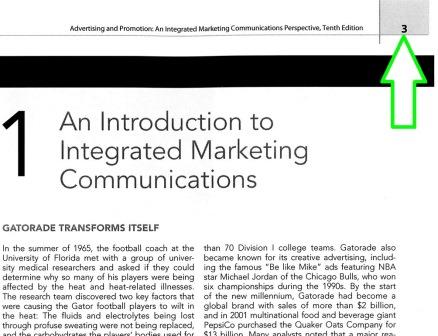
Reading assignments
use "TB" to indicate pages from the textbook, which is a compilation drawn
from a larger book. The page numbers refer to those of the compilation found
in a gray box at the outside top corner of each page as indicated by the
green arrow of the sample page to left of this paragraph. The reading
assignments below will also note the chapter of the source material
textbook, Belch & Belch, Advertising & Promotion, 10th edition
(2015) ISBN 0078028973. "Packet" references required content found in one of
the packets from Sofy Copy Center.
The "recommended" readings are listed
following suggestions from former students of this class who felt that they
would help you understand the materials.
Links for online articles marked
by "**" require that you use an AU computer or a
computer/phone/tablet using the campus Wi-Fi network. Being logged onto an
AU internet address is recognized by the publication's system which then
gives access to their subscription-required web pages. This also works if
you are logged into the system of any other organization with a
subscription, or if you are away from campus, it works then same if
you are logged into the AU VPN.
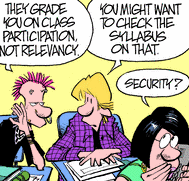
The pictures throughout this syllabus are relevant to the
nearby content, and most have links provided for your interest or
amusement
In MKTG 4320, "Syllabus Day" is not a thing. Topics will be covered in
roughly one per week, though some topics take more class time and other
topics will be covered in a day.
II. Mass Communications Strategy (topics 5-7) Topic 5) Creative Strategy
TB, pg. 212-246 [Belch &
Belch ch 8]
packet: Garfield, all of his ad
reviews in packet
recommended: Advertising
Only a Copywriter Could Love Topic 6) Media Strategy
electronic handout, "Media
Strategy Terms"
electronic handout,
"Understanding Advertising Clutter"
electronic handout, ".....The
Nature of Vehicle Options"
TB, pg. 248-283 [Belch &
Belch ch 10]
recommended: **Is
There a Strategy Behind Buying Advertising time and Space? Topic 7) Budget Setting
TB, p.186 (bottom of page) to
p.210 (second half of Belch & Belch ch 7)
→ this is the remainder of the chapter
started under Topic #4
- Test 2 -
III. Media Vehicle Options & Strategy
Effectiveness (topics 8-12) Topic 8) Media Options: Broadcast
electronic handout, "Media
Strategy Terms"
electronic handout,
"Understanding Advertising Clutter"
electronic handout, ".....The
Nature of Vehicle Options"
→the above 3 readings are the
same handouts from topic #6
→READ ALL 3 AGAIN!
TB, pg. 286-325 [Belch &
Belch ch 11] Topic 9) Media Options: Print
TB, pg. 326-361 [Belch &
Belch ch 12] Topic 10) Media Options: Support Media
TB, pg. 362-387 (LO 13-3); 389;
391 (LO 15-1)-396, 398, 415 (metrics)-420
[most of Belch & Belch ch 13 & 15]
packet: "Letters to My Late Dog"
(Horne)
optional: [the not-assigned pages
of the two textbook chapters]
recommended: **Movie
Theaters' Suicide-by-Advertising Topic 11) Sales Promotion & Publicity (but not PR)
TB, pg. 422-458; 464-467;
486-489; 498-499
[most of Belch & Belch ch 16 & 17]
optional: [the not-assigned pages
of the two textbook chapters] Topic 12) Measuring Effects & Predicting Strategy Effectiveness
TB, pg. 502-540 [Belch &
Belch ch 18]
packet: "The Enigma of Copy
Testing" (Weilbacher)
(Are you
reading the discussion questions?)
recommended: **Snapshot
or Painting?
IV.
The Past As Prologue Topic 13) Semester Review: a Perspective for the Future
If you have trouble sleeping: Distinguished
Erskine Lecture
**Links for these articles require that you use an AU computer or a
computer/phone/tablet using the campus Wi-Fi network. Being logged onto an
AU internet address is recognized by the publication's system which then
gives access to their subscription-required web pages. This also works if
you are logged into the system of any other organization with a
subscription, or if away from campus, and logged into the AU VPN.

 is because of a fact of the
advertising business: advertising decision makers are rarely
(if ever) members of their target audiences. This does not prevent them from
communicating with those audiences, but a failure to recognize that the fact
exists does. This means that they must make decisions based on what a target
audience might perceive and understand, not in terms of what personally
appeals to the decision maker. As a result, the mass communications
managers' success can require constructing strategies for products, services
and consumer choices with which the manager might personally disagree.
is because of a fact of the
advertising business: advertising decision makers are rarely
(if ever) members of their target audiences. This does not prevent them from
communicating with those audiences, but a failure to recognize that the fact
exists does. This means that they must make decisions based on what a target
audience might perceive and understand, not in terms of what personally
appeals to the decision maker. As a result, the mass communications
managers' success can require constructing strategies for products, services
and consumer choices with which the manager might personally disagree. 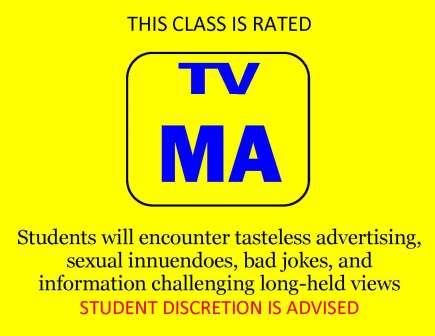 Similarly,
class discussions and videos will use examples of products or services some
people in the class would not buy, using mass communications strategies that
would never consider them part of the target audience, with the potential
result of course materials that some students might find personally
offensive. In MKTG 4320, as in business, it is unavoidable. In addition,
video segments are used for their entertaining approach to explaining class
materials in a way that the instructor is not capable of doing. Many are
taken from advertising-supported television programs for which copyright
allows "fair use" in a classroom. These video segments are not screened to
protect adult AU juniors and seniors from exposure to expletives heard on
FX, TBS, SyFy or CBS networks, scatological references, and formerly
innocent metaphors or acronyms whose current colloquial coital innuendoes
might not be discerned by anyone who hasn't read current Urban Dictionary
definitions
Similarly,
class discussions and videos will use examples of products or services some
people in the class would not buy, using mass communications strategies that
would never consider them part of the target audience, with the potential
result of course materials that some students might find personally
offensive. In MKTG 4320, as in business, it is unavoidable. In addition,
video segments are used for their entertaining approach to explaining class
materials in a way that the instructor is not capable of doing. Many are
taken from advertising-supported television programs for which copyright
allows "fair use" in a classroom. These video segments are not screened to
protect adult AU juniors and seniors from exposure to expletives heard on
FX, TBS, SyFy or CBS networks, scatological references, and formerly
innocent metaphors or acronyms whose current colloquial coital innuendoes
might not be discerned by anyone who hasn't read current Urban Dictionary
definitions
 Reading assignments
use "TB" to indicate pages from the textbook, which is a compilation drawn
from a larger book. The page numbers refer to those of the compilation found
in a gray box at the outside top corner of each page as indicated by the
green arrow of the sample page to left of this paragraph. The reading
assignments below will also note the chapter of the source material
textbook, Belch & Belch, Advertising & Promotion, 10th edition
(2015) ISBN 0078028973. "Packet" references required content found in one of
the packets from Sofy Copy Center.
Reading assignments
use "TB" to indicate pages from the textbook, which is a compilation drawn
from a larger book. The page numbers refer to those of the compilation found
in a gray box at the outside top corner of each page as indicated by the
green arrow of the sample page to left of this paragraph. The reading
assignments below will also note the chapter of the source material
textbook, Belch & Belch, Advertising & Promotion, 10th edition
(2015) ISBN 0078028973. "Packet" references required content found in one of
the packets from Sofy Copy Center. 

 IV.
The Past As Prologue
IV.
The Past As Prologue